


Page 346 - A GRAMMAR OF BHOJPURI _ PhD Dissertation 2020 TU
P. 346
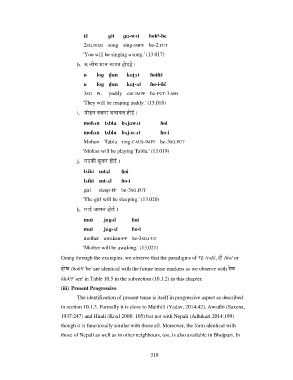
tẽ        ɡit   ɡɑ-wʌt     ɦokʰ-be
                                    2SG.NOM  song  sing-IMPF  be-2.FUT

                                    'You will be singing a song.' (13.017)
                                 h.  ऊ लोग धान काटत होइह& ।

                                    u    loɡ  d ̤ ɑn   kɑʈʌt    ɦoiɦẽ
                                    u    loɡ  d ̤ ɑn   kɑʈ-ʌt   ɦo-i-ɦẽ

                                    3SG  PL   paddy  cut-IMPF  be-FUT-3.MH
                                    'They will be reaping paddy.' (13.018)

                                 i.   मोहन तबला बजावत होई ।

                                    moɦʌn  tʌblɑ  bʌjɑwʌt           ɦoi
                                    moɦʌn  tʌblɑ  bʌj-ɑ-ʌt          ɦo-i
                                    Mohan  Tabla  ring-CAUS-IMPF  be-3SG.FUT

                                    'Mohan will be playing Tabla.' (13.019)

                                 j.   लइकS सुतल होई ।
                                    lʌiki  sutʌl    ɦoi

                                    lʌiki  sut-ʌl   ɦo-i
                                    girl   sleep-PP  be-3SG.FUT
                                    'The girl will be sleeping.' (13.020)

                                 k.  माई जागल होई ।

                                    mɑi     jɑɡʌl       ɦoi
                                    mɑi     jɑɡ-ʌl      ɦo-i

                                    mother  awaken-PP  be-3SG.FUT
                                    'Mother will be awaking.' (13.021)

                           Going through the examples, we observe that the paradigms of रह /rʌɦ/, हो /ɦo/ or
                           होख /ɦokʰ/ 'be' are identical with the future tense markers as we observe with देख

                           /dekʰ/ 'see' in Table 10.5 in the subsection (10.1.2) in this chapter.

                           (iii) Present Progressive
                                 The identification of present tense is itself in progressive aspect as described
                           in section 10.1.3. Formally it is close to Maithili (Yadav, 2014:42), Awadhi (Saxena,

                           1937:247) and Hindi (Koul 2008: 105) but not with Nepali (Adhikari 2014:199)
                           though it is functionally similar with those all. Moreover, the form identical with

                           those of Nepali as well as in other neighbours, too, is also available in Bhojpuri. In


                                                                318

