


Page 55 - Bhojpuri Verb Morphology
P. 55
4.2 Aspect
Aspects are different ways of viewing the internal temporal constituency of a situation
(Comrie:1976). Katamba notes (1993:221) that aspect indicates whether an event,
state, process or action that is denoted by a verb is completed or in progress.
It is a category used in the grammatical description of verb (along with tense and
mood), referring primarily to the way the grammar marks the duration or types of
temporal activity denoted by the verb (Crystal 2003:36).
Being an Indo-Aryan language, Bhojpuri characterizes different kinds of aspects.
Aspectual contrast in Bhojpuri can be divided into two categories; perfective and
imperfective.
4.2.1 Perfective aspect
Perfective aspect looks the situation from outside, not necessarily at any internal
structure of the situation. According to Crystal (2003:342) in perfective aspect, a
situation is seen as a whole, regardless of the time contrast which may be a part of it.
The concept of perfectivity indicates a short period of time, a punctuation or
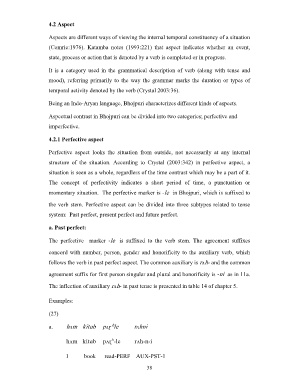
momentary situation. The perfective marker is - in Bhojpuri, which is suffixed to
the verb stem. Perfective aspect can be divided into three subtypes related to tense
system: Past perfect, present perfect and future perfect.
a. Past perfect:
The perfective marker - is suffixed to the verb stem. The agreement suffixes
concord with number, person, gender and honorificity to the auxiliary verb, which
follows the verb in past perfect aspect. The common auxiliary is - and the common
agreement suffix for first person singular and plural and honorificity is - as in 11a.
The inflection of auxiliary - in past tense is presented in table 14 of chapter 5.
Examples:
(27)
a.
---
I book read-PERF AUX-PST-1
38

