


Page 50 - Bhojpuri Verb Morphology
P. 50
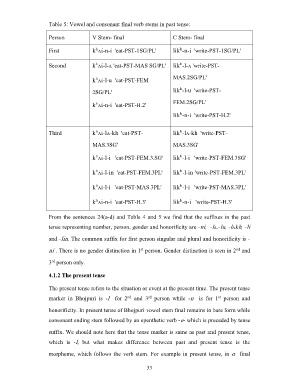
Table 5: Vowel and consonant final verb stems in past tense:
Person V Stem- final C Stem- final
First -- 'eat-PST-1SG/PL' -- 'write-PST-1SG/PL'
Second -- 'eat-PST-MAS SG/PL' -- 'write-PST-
-- 'eat-PST-FEM MAS.2SG/PL'
2SG/PL' -- 'write-PST-
-- 'eat-PST-H.2' FEM.2SG/PL'
-- 'write-PST-H.2'
Third -- 'eat-PST- -- 'write-PST-
MAS.3SG' MAS.3SG'
-- 'eat-PST-FEM.3.SG' -- 'write-PST-FEM.3SG'
-- 'eat-PST-FEM.3PL' --'write-PST-FEM.3PL'
-- 'eat-PST-MAS.3PL' -- 'write-PST-MAS.3PL'
-- 'eat-PST-H.3' -- 'write-PST-H.3'
From the sentences 24(a-d) and Table 4 and 5 we find that the suffixes in the past
tense representing number, person, gender and honorificity are -, -,-, -, -
and -. The common suffix forfirst person singular and plural and honorificity is -
st
nd
. There is no gender distinction in 1 person. Gender distinction is seen in 2 and
3 person only.
rd
4.1.2 The present tense
The present tense refers to the situation or event at the present time. The present tense
nd
st
rd
marker in Bhojpuri is - for 2 and 3 person while - is for 1 person and
honorificity. In present tense of Bhojpuri vowel stem final remains in bare form while
consonant ending stem followed by an epenthetic verb -- which is preceded by tense
suffix. We should note here that the tense marker is same as past and present tense,
which is -, but what makes difference between past and present tense is the
morpheme, which follows the verb stem. For example in present tense, in final
33

