


Page 549 - A GRAMMAR OF BHOJPURI _ PhD Dissertation 2020 TU
P. 549
14.3.5 Pronouns and zero anaphors vs. R-dislocated definite full-NPs
The antecedents of zero or bound pronouns are found most commonly in the
directly preceding clause, as aleady noted (in 14.3.1). The antecedent co-referent of the
stressed independent pronoun is found within two to three clauses back. In contrast, the
antecedent co-referent of definite full-NPs is found much further away in the preceding
discourse, often not even in the same chain or paragraph, as shown in (18a-i).
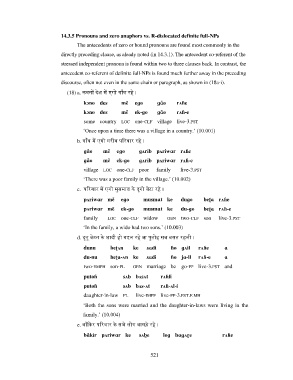
(18) a. कवनY देश म1 एगो गाँव रहे ।
kɔno des mẽ eɡo ɡɑ ̃ o rʌɦe
kɔno des mẽ ek-ɡo ɡɑ ̃ o rʌɦ-e
some country LOC one-CLF village live-3.PST
Once upon a time there was a village in a country. (10.001)
b. गाँव म1 एगो गरीब प[रवार रहे ।
ɡɑ ̃ o mẽ eɡo ɡʌrib pʌriwɑr rʌɦe
ɡɑ ̃ o mẽ ek-ɡo ɡʌrib pʌriwɑr rʌɦ-e
village LOC one-CLF poor family live-3.PST
There was a poor family in the village. (10.002)
c. प[रवार म1 एगो मुसमात के दूगो बेटा रहे ।
pʌriwɑr mẽ eɡo musmɑt ke duɡo beʈɑ rʌɦe
pʌriwɑr mẽ ek-ɡo musmɑt ke du-ɡo beʈɑ rʌɦ-e
family LOC one-CLF widow GEN two-CLF son live-3.PST
In the family, a wido had two sons. (10.003)
d. दूनू बेटन के शादी हो गइल रहे आ पुतोह सब बसत रहली ।
dunu beʈʌn ke sɑdi ɦo ɡʌil rʌɦe ɑ
du-nu beʈɑ-ʌn ke sɑdi ɦo jɑ-il rʌɦ-e ɑ
two-EMPH son-PL GEN marriage be go-PP live-3.PST and
putoɦ sʌb bʌsʌt rʌɦli
putoɦ sʌb bʌs-ʌt rʌɦ-ʌl-i
daughter-in-law PL live-IMPF live-PP-3.PST.F.MH
Both the sons were married and the daughter-in-laws were living in the
family. (10.004)
e. बाँ*कर प[रवार के सभे लोग बागड़े रहे ।
bɑ ̃ kir pʌriwɑr ke sʌb ̤ e loɡ bɑɡʌɽe rʌɦe
521

