


Page 545 - A GRAMMAR OF BHOJPURI _ PhD Dissertation 2020 TU
P. 545
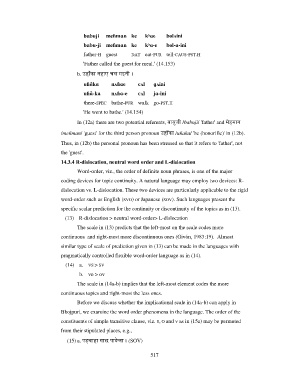
bɑbuji   meɦmɑn  ke       kʰɑe     bolʌini
                                    bɑbu-ji  meɦmɑn  ke       kʰɑ-e    bol-ɑ-ini

                                    father-H  guest     DAT  eat-PUR  tell-CAUS-PST.H
                                    'Father called the guest for meal.' (14.153)

                                 b. उहाँका नहाए चल गइनी ।
                                    uɦɑ ̃ kɑ    nʌɦɑe      cʌl   ɡʌini

                                    uɦɑ ̃ -kɑ   nʌɦɑ-e     cʌl   jɑ-ini
                                    there-SPEC  bathe-PUR  walk  go-PST.H

                                    'He went to bathe.' (14.154)
                                 In (12a) there are two potential referents, बाबुजी /bɑbuji/ 'father' and मेहमान

                           /meɦmɑn/ 'guest' for the third person pronoun उहाँका /uɦɑkɑ/ 'he (honorific)' in (12b).

                           Thus, in (12b) the personal pronoun has been stressed so that it refers to 'father', not
                           the 'guest'.

                           14.3.4 R-dislocation, neutral word order and L-dislocation
                                 Word-order, viz., the order of definite noun phrases, is one of the major
                           coding devices for topic continuity. A natural language may employ two devices: R-

                           dislocation vs. L-dislocation. These two devices are particularly applicable to the rigid
                           word-order such as English (SVO) or Japanese (SOV). Such languages present the

                           specific scalar prediction for the continuity or discontinuity of the topics as in (13).
                            (13)  R-dislocation > neutral word-order> L-dislocation

                                 The scale in (13) predicts that the left-most on the scale codes more
                           continuous  and right-most more discontinuous ones (Givón, 1983:19).  Almost

                           similar type of scale of prediction given in (13) can be made in the languages with
                           pragmatically controlled flexible word-order language as in (14).
                            (14)  a.  VS > SV

                                  b.  vo > ov
                                 The scale in (14a-b) implies that the left-most element codes the more

                           continuous topics and right-most the less ones.
                                 Before we discuss whether the implicational scale in (14a-b) can apply in

                           Bhojpuri, we examine the word order phenomena in the language. The order of the
                           constituents of simple transitive clause, viz. S, O and v as in (15a) may be permuted

                           from their stipulated places, e.g.,
                             (15) a. पVवाहा गाछ पाङेला । (SOV)


                                                                517

