


Page 547 - A GRAMMAR OF BHOJPURI _ PhD Dissertation 2020 TU
P. 547
(a) SOV is a common neutral word-order in other Indo-Aryan languages,
                                 especially the close neighbours of Bhojpuri such as Chitoniya Tharu, Maithili
                                            7
                                 and Awadhi  with Hindi (Koul 2008:216) and Nepali (Upadhyay 2010:88)
                                 including some Tibeto-Burman languages like Chapang (Caughley, 1982),
                                 Newar (Malla, 1985), Gurung (Glover, 1974), Dolkha Newar (Genetti, 2007),

                                 Kham (Watters, 2001), Khwopa Newar (Regmi, 2012), Bhujel (Regmi, 2012)
                                 and Kaike (Regmi, 2013) and Dhimal (Khatiwada 2016).

                              (b) The native speakers have a strong feeling that SOV is the basic constituent
                                 order in Bhojpuri. Moreover, it is the most frequent, least marked and

                                 pragmatically neutral (Whaley, 1997:106).
                                 The clauses in (15b-f) show the permutation of the constituents in the simple

                           transitive clause. However, the change in order generally triggers a change in the
                           meaning of the permutated elements from its stipulated place, already exemplified.
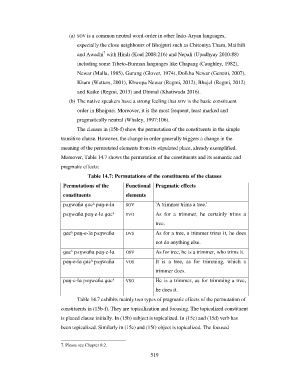
                           Moreover, Table 14.7 shows the permutation of the constituents and its semantic and

                           pragmatic effects:
                                      Table 14.7: Permutations of the constituents of the clauses

                           Permutations of the        Functional   Pragmatic effects
                           constituents               elements

                           pʌŋwɑɦɑ ɡɑcʰ pɑŋ-e-lɑ      SOV         'A trimmer trims a tree.'
                           pʌŋwɑɦɑ pɑŋ-e-lɑ ɡɑcʰ      SVO         As  for  a  trimmer,  he  certainly  trims  a

                                                                  tree.
                           ɡɑcʰ pɑŋ-e-lɑ pʌŋwɑɦɑ      OVS         As for a tree, a trimmer trims it, he does

                                                                  not do anything else.
                           ɡɑcʰ pʌŋwɑɦɑ pɑŋ-e-lɑ      OSV         As for tree, he is a trimmer, who trims it.

                           pɑŋ-e-lɑ ɡɑcʰ pʌŋwɑɦɑ      VOS         It  is  a  tree,  as  for  trimming,  which  a
                                                                  trimmer does.
                           pɑŋ-e-lɑ pʌŋwɑɦɑ ɡɑcʰ      VSO         He is a trimmer, as for trimming a tree,

                                                                  he does it.

                                 Table 14.7 exhibits mainly two types of pragmatic effects of the permutation of
                           constituents in (15b-f). They are topicalization and focusing. The topicalized constituent
                           is placed clause initially. In (15b) subject is topicalized. In (15c) and (15d) verb has

                           been topicalized. Similarly in (15e) and (15f) object is topicalized. The focused


                           7. Please see Chapter 8.2.
                                                                519

