


Page 540 - A GRAMMAR OF BHOJPURI _ PhD Dissertation 2020 TU
P. 540
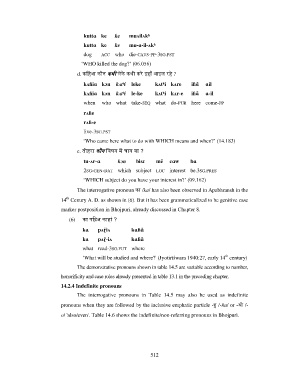
kuttɑ ke ke muʌilʌkʰ
kuttɑ ke ke mu-ɑ-il-ʌkʰ
dog ACC who die-CAUS-PP-3SG.PST
WHO killed the dog? (06.056)
d. किहआ कौन कथी लेके कथी करे इहाँ आइल रहे ?
kʌɦiɑ kɔn kʌtʰi leke kʌtʰi kʌre iɦɑ ̃ ɑil
kʌɦiɑ kɔn kʌtʰi le-ke kʌtʰi kʌr-e iɦɑ ̃ ɑ-il
when who what take-SEQ what do-PUR here come-PP
rʌɦe
rʌɦ-e
live-3SG.PST
Who came here what to do with WHICH means and when? (14.183)
e. तोहरा कौन िवषय म1 चाव बा ?
tu-ʌr-ɑ kɔn bisɛ mẽ cɑw bɑ
2SG-GEN-DAT which subject LOC interest be.3SG.PRES
WHICH subject do you have your interest in? (09.162)
The interrogative pronoun का /kɑ/ has also been observed in Apabhransh in the
th
14 Cenury A. D. as shown in (6). But it has been grammaticalized to be genitive case
marker postposition in Bhojpuri, already discussed in Chapter 8.
(6) का प*ढ़अ काहां ?
kɑ pʌɽ ̊ iʌ kɑɦɑ ̃
kɑ pʌɽ ̊ -iʌ kɑɦɑ ̃
what read-3SG.FUT where
th
'What will be studied and where?' (Jyotirīśwara 1940:27, early 14 century)
The demonstrative pronouns shown in table 14.5 are variable according to number,
honorificity and case roles already presented in table 13.1 in the preceding chapter.
14.2.4 Indefinite pronouns
The interrogative pronouns in Table 14.5 may also be used as indefinite
pronouns when they are followed by the inclusive emphatic particle -5 /-ɦu/ or -ओ /-
o/ 'also/even'. Table 14.6 shows the indefinite/non-referring pronouns in Bhojpuri.
512

