


Page 538 - A GRAMMAR OF BHOJPURI _ PhD Dissertation 2020 TU
P. 538
Moreover, the third person Bhojpuri pronouns differ from each other in terms
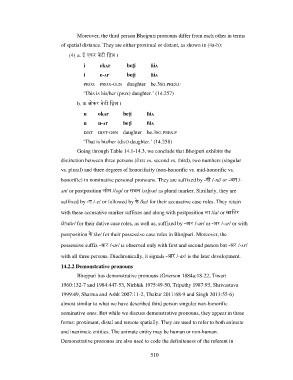
of spatial distance. They are either proximal or distant, as shown in (4a-b):
(4) a. ई एकर बेटी िहअ ।
i ekʌr beʈi ɦiʌ
i e-ʌr beʈi ɦiʌ
PROX PROX-GEN daughter be.3SG.PRES.F
This is his/her (prox) daughter. (14.257)
b. ऊ ओकर बेटी िहअ ।
u okʌr beʈi ɦiʌ
u u-ʌr beʈi ɦiʌ
DIST DIST-GEN daughter be.3SG.PRES.F
That is his/her (dist) daughter. (14.258)
Going through Table 14.1-14.3, we conclude that Bhojpuri exhibits the
distinction between three persons (first vs. second vs. third), two numbers (singular
vs. plural) and three degrees of honorificity (non-honorific vs. mid-honorific vs.
honorific) in nominative personal pronouns. They are suffixed by -नी /-ni/ or -अन /-
ʌn/ or postposition लोग /loɡ/ or सभन /sʌb ̤ ʌn/ as plural marker. Similarly, they are
suffixed by -ए /-e/ or followed by के /ke/ for their accusative case roles. They retain
with these accusative marker suffixes and along with postposition ला /lɑ/ or खाितर
/kʰɑtir/ for their dative case roles, as well as, suffixed by -आर /-ɑr/ or -अर /-ʌr/ or with
postposition के /ke/ for their possessive case roles in Bhojpuri. Moreover, the
possessive suffix -आर /-ɑr/ is observed only with first and second person but -अर /-ʌr/
with all three persons. Diachronically, it signals -आर /-ɑr/ is the later development.
14.2.2 Demonstrative pronouns
Bhojpuri has demonstrative pronouns (Grierson 1884a:18-22, Tiwari
1960:132-7 and 1984:447-53, Nirbhik 1975:49-50, Tripathy 1987:93, Shrivastava
1999:49, Sharma and Ashk 2007:11-2, Thakur 2011:68-9 and Singh 2013:55-6)
almost similar to what we have described third person singular non-honorific
nominative ones. But while we discuss demonstrative pronouns, they appear in three
forms: proximant, distal and remote spatially. They are used to refer to both animate
and inanimate entities. The animate entity may be human or non-human.
Demonstrative pronouns are also used to code the definiteness of the referent in
510

