


Page 533 - A GRAMMAR OF BHOJPURI _ PhD Dissertation 2020 TU
P. 533
14.2.1 Personal pronouns
                                 Person, number, honorificity and case roles are categories of the Bhojpuri

                           pronouns (Grierson 1884a:14-7, Ojha 1915[1982]:18-9, Tiwari 1960:126-32 and
                           1984:440-7, Nirbhik 1975:48, Tripathy 1987:92-3, Shrivastava 1999:48-9, Sharma and
                           Ashk 2007:10-1, Thakur 2011:66-8 and Singh 2013:55). There are three persons: first,

                           second and third; two numbers: singular and plural and three degrees of honorificity:
                           non-honorific, mid-honorific and honorific. Regarding the gender, pronouns are not

                           suffixed or take any other particles for gender, rather, the gender of a personal pronoun
                           is fixed by gender suffix with the finite verbs. Likewise, the case roles are generally

                           classified by suffixing the nominative/agentive case for other case roles. Such suffixes
                           are also attached with the pronouns in nominative case to change them into accusative,

                           dative and possessive cases only. The other case roles are fixed by postpositional
                           morphemes in Bhojpuri, as nominals do, already described in Chapter 6. The personal
                           pronouns in Bhojpuri refer deictically to the speech-act participants. Personal pronouns

                           are free standing and take case markers and postpositions in the same way as do the full
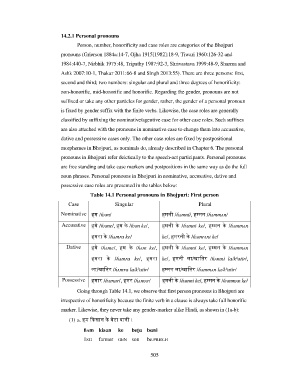
                           noun phrases. Personal pronouns in Bhojpuri in nominative, accusative, dative and

                           possessive case roles are presented in the tables below:
                                       Table 14.1 Personal pronouns in Bhojpuri: First person

                              Case               Singular                           Plural
                           Nominative  हम /ɦʌm/                      हमनी /ɦʌmni/, ह"मन /ɦʌmmʌn/

                           Accusative  हमे /ɦʌme/, हम के /ɦʌm ke/,   हमनी  के  /ɦʌmni  ke/,  ह"मन  के  /ɦʌmmʌn

                                       हमरा के /ɦʌmrɑ ke/            ke/, हमरनी के /ɦʌmrʌni ke/

                             Dative    हमे  /ɦʌme/,  हम  के  /ɦʌm  ke/,  हमनी  के  /ɦʌmni  ke/,  ह"मन  के  /ɦʌmmʌn

                                       हमरा  के  /ɦʌmrɑ  ke/,  हमरा  ke/,  हमनी  ला/खाितर  /ɦʌmni  lɑ/kʰɑtir/,

                                       ला/खाितर /ɦʌmrɑ lɑ/kʰɑtir/    ह"मन ला/खाितर /ɦʌmmʌn lɑ/kʰɑtir/

                           Possessive  हमार /ɦʌmɑr/, हमर /ɦʌmʌr/     हमनी के /ɦʌmni ke/, ह"मन के /ɦʌmmʌn ke/
                                 Going through Table 14.1, we observe that first person pronouns in Bhojpuri are

                           irrespective of honorificity because the finite verb in a clause is always take full honorific
                           marker. Likewise, they never take any gender-marker ulike Hindi, as shown in (1a-b):

                              (1) a. हम *कसान के बेटा बानी ।

                                    ɦʌm  kisɑn  ke      beʈɑ  bɑni
                                    1SG   farmer  GEN  son    be.PRES.H


                                                                505

