Page 535 - A GRAMMAR OF BHOJPURI _ PhD Dissertation 2020 TU
P. 535
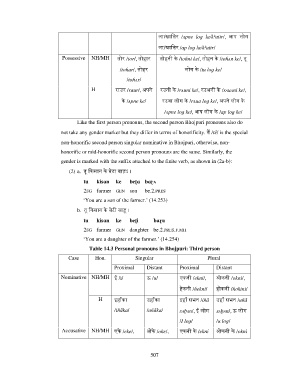
ला/खाितर  /ʌpne  loɡ  lɑ/kʰɑtir/,  आप  लोग

                                                                   ला/खाितर / ɑp loɡ lɑ/kʰɑtir/

                           Possessive  NH/MH      तोर /tor/, तोहार   तोहनी के /toɦni ke/, तोहन के /toɦʌn ke/, तू
                                                   /toɦɑr/, तोहर              लोग के /tu loɡ ke/

                                                      /toɦʌr/

                                       H         राउर /rɑur/, अपने   रउनी के /rʌuni ke/, रउअनी के /rʌuʌni ke/,

                                                    के /ʌpne ke/     रउआ लोग के /rʌuɑ loɡ ke/, अपने लोग के

                                                                      /ʌpne loɡ ke/, आप लोग के /ɑp loɡ ke/
                                 Like the first person pronouns, the second person Bhojpuri pronouns also do

                           not take any gender marker but they differ in terms of honorificity. त1 /tẽ/ is the special

                           non-honorific second person singular nominative in Bhojpuri, otherwise, non-
                           honorific or mid-honorific second person pronouns are the same. Similarly, the

                           gender is marked with the suffix attached to the finite verb, as shown in (2a-b):
                              (2) a.  तू *कसान के बेटा बाड़ऽ ।

                                    tu   kisɑn  ke     beʈɑ  bɑɽʌ
                                    2SG  farmer  GEN  son     be.2.PRES

                                    ‘You are a son of the farmer.’ (14.253)
                                 b.  तू *कसान के बेटी बाड़ू ।

                                    tu   kisɑn  ke     beʈi      bɑɽu
                                    2SG  farmer  GEN  daughter  be.2.PRES.F.MH

                                    ‘You are a daughter of the farmer.’ (14.254)
                                      Table 14.3 Personal pronouns in Bhojpuri: Third person

                              Case       Hon.             Singular                      Plural
                                                 Proximal     Distant       Proximal       Distant

                           Nominative  NH/MH  ई /i/           ऊ /u/         एकनी /ekni/,   ओकनी /okni/,

                                                                            हेकनी /ɦekni/   होकनी /ɦokini/
                                          H      इहाँका       उहाँका        इहाँ सभन /iɦɑ  ̃  उहाँ सभन /uɦɑ  ̃

                                                 /iɦɑkɑ/      /uɦɑkɑ/       sʌb ̤ ʌn/, ई लोग   sʌb ̤ ʌn/, ऊ लोग
                                                                  ̃
                                                    ̃
                                                                            /I loɡ/        /u loɡ/

                           Accusative  NH/MH  एके /eke/,      ओके /oke/,    एकनी के /ekni   ओकनी के /okni


                                                                507
   530   531   532   533   534   535   536   537   538   539   540