


Page 445 - A GRAMMAR OF BHOJPURI _ PhD Dissertation 2020 TU
P. 445
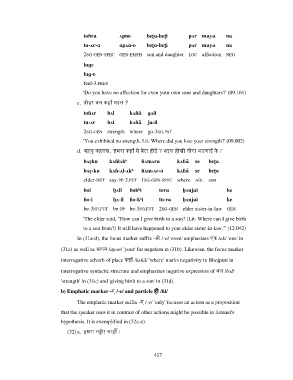
toɦrɑ ʌpno beʈɑ-beʈi pʌr mɑyɑ nɑ
tu-ʌr-ɑ ɑpʌn-o beʈɑ-beʈi pʌr mɑyɑ nɑ
2SG-GEN-SPEC GEN-EMPH son and daughter LOC affection NEG
lɑɡe
lɑɡ-e
feel-3.PRES
'Do you have no affection for even your own sons and daughters?' (09.161)
c. तोहर बल कहाँ गइल ?
toɦʌr bʌl kʌɦɑ ̃ ɡʌil
tu-ʌr bʌl kʌɦɑ ̃ jɑ-il
2SG-GEN strength where go-3SG.PST
'You exhibited no strength. Lit: Where did you lose your strength?' (09.002)
d. बड़कु कहलख, हमरा कहाँ से बेटा होई ? भइल होखी तोरा भउजाई के ।
bʌɽku kʌɦlʌkʰ ɦʌmʌrɑ kʌɦɑ ̃ se beʈɑ
bʌɽ-ku kʌɦ-ʌl-ʌkʰ ɦʌm-ʌr-ɑ kʌɦɑ ̃ se beʈɑ
elder-DET say-PP-3.PST 1SG-GEN-SPEC where ABL son
ɦoi b ̤ ʌil ɦokʰi torɑ b ̤ ʌujɑi ke
ɦo-i b̤ ʌ-il ɦo-kʰi tu-rɑ b̤ ʌujɑi ke
be-3SG.FUT be-PP be-3SG.FUT 2SG-GEN elder sister-in-law GEN
'The elder said, "How can I give birth to a son? (Lit: Where can I give birth
to a son from?) It will have happened to your elder sister-in-law."' (12.042)
In (31a-d), the focus marker suffix -ओ /-o/ 'even' emphasizes एक /ek/ 'one' in
(31a) as well as आपन /ɑpʌn/ 'your' for negation in (31b). Likewise, the focus marker
interrogative adverb of place कहाँ /kʌɦɑ/ 'where' marks negativity in Bhojpuri in
̃
interrogative syntactic structure and emphasizes negative expression of बल /bʌl/
'strength' in (31c) and 'giving birth to a son' in (31d).
b) Emphatic marker -ए /-e/ and particle ही /ɦi/
The emphatic marker suffix -ए /-e/ 'only' focuses an action as a proposition
that the speaker uses it in contrast of other actions might be possible in listener's
hypothesis. It is exemplified in (32a-e).
(32) a. हमरा ग1ँए चाही ँ ।
417

