


Page 444 - A GRAMMAR OF BHOJPURI _ PhD Dissertation 2020 TU
P. 444
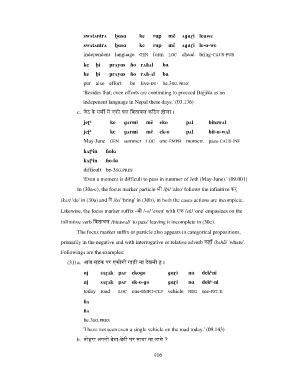
swʌtʌntrʌ    b ̤ ɑsɑ   ke    rup   mẽ  ʌɡɑɽi  leɑwe
                                    swʌtʌntrʌ    b ̤ ɑsɑ   ke    rup   mẽ  ʌɡɑɽi  le-ɑ-we

                                    independent  language  GEN  form  LOC  ahead  bring-CAUS-PUR

                                    ke  b ̤ i   prʌyɑs  ɦo  rʌɦʌl    bɑ
                                    ke  b ̤ i   prʌyɑs  ɦo  rʌɦ-ʌl   bɑ
                                    pur  also  effort   be  live-INF  be.3SG.PRES

                                    'Besides that, even efforts are continuing to proceed Bajjika as an
                                    indepenent language in Nepal these days.' (03.136)

                                 c.  जेठ के गम~ म" एको पल िबतावल कcठन होला ।
                                    jeʈʰ       ke    ɡʌrmi    mẽ  eko          pʌl      bitɑwʌl

                                    jeʈʰ       ke    ɡʌrmi    mẽ  ek-o         pʌl      bit-ɑ-wʌl
                                    May-June  GEN  summer  LOC  one-EMPH  moment  pass-CAUS-INF

                                    kʌʈʰin   ɦolɑ
                                    kʌʈʰin   ɦo-lɑ

                                    difficult  be-3SG.PRES
                                    'Even a moment is difficult to pass in summer of Jeth (May-June).' (09.001)
                                 In (30a-c), the focus marker particle भी /b ̤ i/ 'also' follows the infinitive कर्


                           /kʌr/ 'do' in (30a) and ले /le/ 'bring' in (30b), in both the cases actions are incomplete.
                           Likewise, the focus marker suffix -ओ /-o/ 'even' with एक /ek/ 'one' empasizes on the

                           infinitive verb िबतावल /bitɑwʌl/ 'to pass' leaving it incomplete in (30c).

                                 The focus marker suffix or particle also appears in categorical propositions,
                                                                                               ̃
                           primarily in the negative and with interrogative or relative adverb कहाँ /kʌɦɑ/ 'where'.
                           Followings are the examples:

                             (31) a.  आज सड़क पर एकोगो गाड़ी ना देखनी ह ।
                                    ɑj     sʌɽʌk  pʌr  ekoɡo           ɡɑɽi     nɑ   dekʰni

                                    ɑj     sʌɽʌk  pʌr  ek-o-ɡo         ɡɑɽi     nɑ   dekʰ-ni
                                    today  road    LOC  one-EMPH-CLF  vehicle  NEG  see-PST.H


                                    ɦʌ
                                    ɦʌ

                                    be.3SG.PRES
                                    'I have not seen even a single vehicle on the road today.' (09.143)

                                 b.  तोहरा अपनो बेटा-बेटी पर माया ना लागे ?


                                                                    416

