


Page 449 - A GRAMMAR OF BHOJPURI _ PhD Dissertation 2020 TU
P. 449
reflexive sense to serve as an intensifier that emphasizes the notion that the implicit
                           subject or agent of the clause or the preceding noun phrase take part in the event

                           itself. This emphasis on one participant implies the exclusion of other possibilities. In
                           Bhojpuri, it is also the form of an honorific second person nominative but that is not
                           relevant here. Following are the examples:

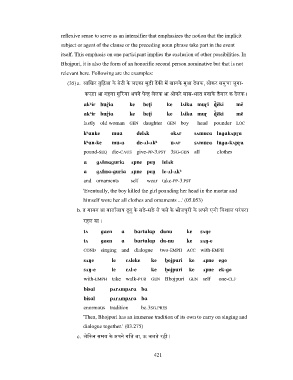
                             (35) a.  आिखर बु&ढ़आ के बेटी के लइका मुड़ी ढ"क8 म" खानके मुआ देलक, ओकर समुचा लुगा-

                                     कपड़ा आ गहना गुcरया अपने पेPह लेलक आ ओकरे मास-भात बनाके तैयार क देलक ।
                                                                                           ̈
                                    ɑkʰir  buɽ ̊ iɑ    ke    beʈi      ke    lʌikɑ  muɽi  ɖẽki      mẽ
                                                                                           ̈
                                    ɑkʰir  buɽ ̊ iɑ    ke    beʈi      ke    lʌikɑ  muɽ  ɖẽki       mẽ

                                    lastly  old woman  GEN  daughter  GEN  boy     head  pounder  LOC

                                    kʰɑnke      muɑ       delʌk         okʌr      sʌmucɑ  luɡɑkʌpɽɑ
                                    kʰɑn-ke     mu-ɑ      de-ʌl-ʌkʰ     u-ʌr      sʌmucɑ  luɡɑ-kʌpɽɑ
                                    pound-SEQ  die-CAUS  give-PP-3.PST  3SG-GEN  all        clothes

                                    ɑ    ɡʌɦnɑɡuriɑ  ʌpne  pen ̥     lelʌk
                                    ɑ    ɡʌɦnɑ-ɡuriɑ  ʌpne  pen ̥    le-ʌl-ʌkʰ
                                    and  ornaments      self   wear  take-PP-3.PST


                                    'Eventually, the boy killed the girl pounding her head in the mortar and
                                    himself wore her all clothes and ornaments ...' (05.053)
                                 b. त गायन आ वाताDलाप दूनू के सङे-सङे ले चले के भोजपुरी के अपने एगो िवशाल परंपरा

                                    रहल बा ।

                                    tʌ     ɡɑen     ɑ    bɑrtɑlɑp  dunu        ke    sʌŋe
                                    tʌ     ɡɑen     ɑ    bɑrtɑlɑp  du-nu       ke    sʌŋ-e

                                    COND  singing  and  dialogue    two-EMPH  ACC  with-EMPH

                                    sʌŋe        le    cʌleke    ke    b ̤ ojpuri  ke   ʌpne  eɡo
                                    sʌŋ-e       le    cʌl-e     ke    b ̤ ojpuri  ke   ʌpne  ek-ɡo
                                    with-EMPH  take  walk-PUR  GEN  Bhojpuri  GEN  self     one-CLF

                                    bisɑl      pʌrʌmpʌrɑ  bɑ
                                    bisɑl      pʌrʌmpʌrɑ  bɑ

                                    enormous  tradition     be.3SG.PRES
                                    'Then, Bhojpuri has an immense tradition of its own to carry on singing and
                                    dialogue together.' (03.275)

                                 c.  ले&कन समय के अपने गित बा, ऊ चलते रही ।


                                                                    421

