


Page 452 - A GRAMMAR OF BHOJPURI _ PhD Dissertation 2020 TU
P. 452
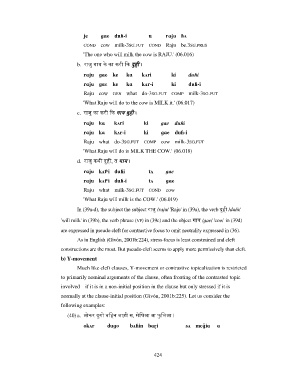
je ɡɑe duɦ-i u rɑju ɦʌ
COND cow milk-3SG.FUT COND Raju be.3SG.PRES
'The one who will milk the cow is RAJU.' (06.016)
b. राजु गाय के का करी &क दुही ।
rɑju ɡɑe ke kɑ kʌri ki duɦi
rɑju ɡɑe ke kɑ kʌr-i ki duɦ-i
Raju cow GEN what do-3SG.FUT COMP milk-3SG.FUT
'What Raju will do to the cow is MILK it.' (06.017)
c. राजु का करी &क गाय दुही ।
rɑju kɑ kʌri ki ɡɑe duɦi
rɑju kɑ kʌr-i ki ɡɑe duɦ-i
Raju what do-3SG.FUT COMP cow milk-3SG.FUT
'What Raju will do is MILK THE COW.' (06.018)
d. राजु कथी दुही, त गाय ।
rɑju kʌtʰi duɦi tʌ ɡɑe
rɑju kʌtʰi duɦ-i tʌ ɡɑe
Raju what milk-3SG.FUT COND cow
'What Raju will milk is the COW.' (06.019)
In (39a-d), the subject the subject राजु /rɑju/ 'Raju' in (39a), the verb दुही /duɦi/
'will milk' in (39b), the verb phrase (VP) in (39c) and the object गाय /ɡɑe/ 'cow' in (39d)
are expressed in pseudo cleft for contrastive focus to omit neutrality expressed in (36).
As in English (Givón, 2001b:224), stress-focus is least constrained and cleft
constructions are the most. But pseudo-cleft seems to apply more permissively than cleft.
b) Y-movement
Much like cleft clauses, Y-movement or contrastive topicalization is restricted
to primarily nominal arguments of the clause, often fronting of the contrasted topic
involved if it is in a non-initial position in the clause but only stressed if it is
normally at the clause-initial position (Givón, 2001b:225). Let us consider the
following examples:
(40) a. ओकर दुगो बिहन बाड़ी स, मेिघआ आ फु िलआ ।
okʌr duɡo bʌɦin bɑɽi sʌ meɡ ̈ iɑ ɑ
424

