


Page 455 - A GRAMMAR OF BHOJPURI _ PhD Dissertation 2020 TU
P. 455
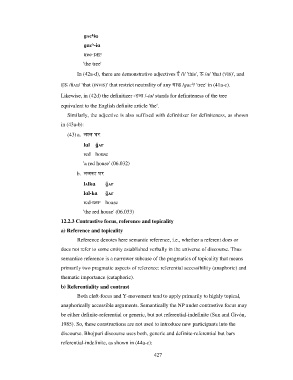
ɡʌcʰiɑ
                                    ɡɑcʰ-iɑ

                                    tree-DEF
                                    'the tree'
                                 In (42a-d), there are demonstrative adjectives ई /i/ 'this', ऊ /u/ 'that (VIS)', and


                           हऊ /ɦʌu/ 'that (INVIS)' that restrict neutrality of any गाछ /ɡɑcʰ/ 'tree' in (41a-c).
                           Likewise, in (42d) the definitizer -इआ /-iɑ/ stands for definiteness of the tree

                           equivalent to the English definite article 'the'.

                             Similarly, the adjective is also suffixed with definitizer for definiteness, as shown
                           in (43a-b):
                             (43) a.  लाल घर

                                    lɑl  ɡ ̈ ʌr

                                    red  house
                                    'a red house' (06.032)

                                 b.  ललका घर
                                    lʌlkɑ    ɡ ̈ ʌr
                                    lɑl-kɑ   ɡ ̈ ʌr

                                    red-DEF  house

                                    'the red house' (06.033)
                           12.2.3 Contrastive focus, reference and topicality

                           a) Reference and topicality
                                 Reference denotes here semantic reference, i.e., whether a referent does or
                           does not refer to some entity established verbally in the universe of discourse. Thus

                           semantice reference is a narrower subcase of the pragmatics of topicality that means
                           primarily two pragmatic aspects of reference: referential accessibility (anaphoric) and

                           thematic importance (cataphoric).
                           b) Referentiality and contrast

                                 Both cleft-focus and Y-movement tend to apply primarily to highly topical,
                           anaphorically accessible arguments. Semantically the NP under contrastive focus may

                           be either definite-referential or generic, but not referential-indefinite (Sun and Givón,
                           1985). So, these constructions are not used to introduce new participants into the
                           discourse. Bhojpuri discourse uses both, generic and definite-referential but bars

                           referential-indefinite, as shown in (44a-c):

                                                                    427

