


Page 403 - A GRAMMAR OF BHOJPURI _ PhD Dissertation 2020 TU
P. 403
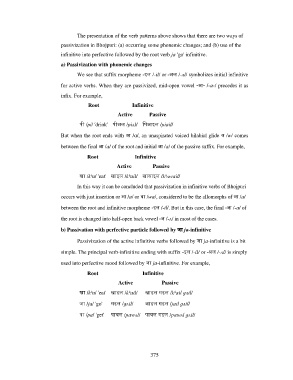
The presentation of the verb patterns above shows that there are two ways of
passivization in Bhojpuri: (a) occurring some phonemic changes; and (b) use of the
infinitive into perfective followed by the root verb j 'go' infinitive.
a) Passivization with phonemic changes
We see that suffix morpheme -इल /-il/ or -अल /-ʌl/ symbolizes initial infinitive
for active verbs. When they are passivized, mid-open vowel -आ- /--/ precedes it as
infix. For example,
Root Infinitive
Active Passive
पी /pi/ 'drink' पीअल /piʌl/ िपआइल /piɑil/
But when the root ends with आ //, an unaspirated voiced bilabial glide व /w/ comes
between the final आ // of the root and initial आ // of the passive suffix. For example,
Root Infinitive
Active Passive
खा /kʰɑ/ 'eat' खाइल /kʰil/ खावाइल /kʰʌwil/
In this way it can be concluded that passivization in infinitive verbs of Bhojpuri
occurs with just insertion or आ // or वा /w/, considered to be the allomorphs of आ //
between the root and infinitive morpheme -इल /-il/. But in this case, the final -आ /-/ of
the root is changed into half-open back vowel -अ /-ʌ/ in most of the cases.
b) Passivation with perfective particle followed by जा j-infinitive
Passivization of the active infinitive verbs followed by जा j-infinitive is a bit
simple. The principal verb-infinitive ending with suffix -इल /-il/ or -अल /-ʌl/ is simply
used into perfective mood followed by जा j-infinitive. For example,
Root Infinitive
Active Passive
खा /kʰɑ/ 'eat' खाइल /kʰil/ खाइल गइल /kʰil ɡʌil/
जा /jɑ/ 'go' गइल /ɡʌil/ जाइल गइल /jil ɡʌil/
पा /pɑ/ 'get' पावल /pwʌl/ पावल गइल /pwʌl ɡʌil/
375

