


Page 366 - A GRAMMAR OF BHOJPURI _ PhD Dissertation 2020 TU
P. 366
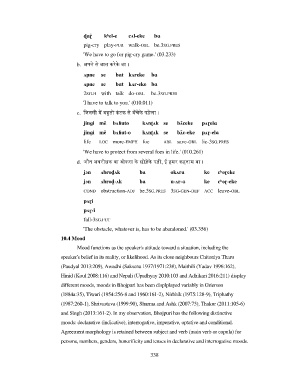
ɖɑɽ ̊    kʰel-e    cʌl-eke   bɑ
                                    pig-cry  play-PUR  walk-OBL  be.3SG.PRES

                                    'We have to go for pig-cry game.' (03.233)
                                 b.  अपने से बात करेके बा ।

                                    ʌpne  se     bɑt  kʌreke  bɑ
                                    ʌpne  se     bɑt  kʌr-eke  bɑ

                                    2SG.H  with  talk  do-OBL   be.3SG.PRES
                                    'I have to talk to you.' (010.011)

                                 c.  िजनगी म& ब"तो कंटक से बँचेके पड़ेला ।

                                    jinɡi  mẽ  bʌɦuto        kʌnʈʌk  se    bʌ ̃ ceke   pʌɽelɑ
                                    jinɡi  mẽ  bʌɦut-o       kʌnʈʌk  se    bʌ ̃ c-eke   pʌɽ-elɑ
                                    life   LOC  more-EMPH  foe       ABL  save-OBL  lie-3SG.PRES

                                    'We have to protect from several foes in life.' (010.261)

                                 d.  जौन अवरोधक बा ओकरा के छोड़ेके पड़ी, ई हमर कहनाम बा ।
                                    jɔn    ʌbrod ̤ ʌk      bɑ           okʌrɑ         ke    cʰoɽeke

                                    jɔn    ʌbrod ̤ -ʌk     bɑ           u-ʌr-ɑ        ke    cʰoɽ-eke
                                    COND  obstruction-ADJ  be.3SG.PRES  3SG-GEN-DEF  ACC  leave-OBL

                                    pʌɽi
                                    pʌɽ-i

                                    fall-3SG.FUT
                                    'The obstacle, whatever is, has to be abandoned.' (03.356)

                           10.4 Mood
                                 Mood functions as the speaker's attitude toward a situation, including the
                           speaker's belief in its reality, or likelihood. As its close neighbours Chitoniya Tharu

                           (Paudyal 2013:209), Awadhi (Saksena 1937/1971:238), Maithili (Yadav 1996:162),
                           Hinid (Koul 2008:116) and Nepali (Upadhyay 2010:103 and Adhikari 2016:211) display

                           different moods, moods in Bhojpuri has been displplayed variably in Grierson
                           (1884a:35), Tiwari (1954:256-8 and 1960:161-2), Nirbhik (1975:128-9), Triphathy

                           (1987:260-1), Shrivastava (1999:90), Sharma and Ashk (2007:73), Thakur (2011:105-6)
                           and Singh (2013:161-2). In my observation, Bhojpuri has the following distinctive

                           moods: declarative (indicative), interrogative, imperative, optative and conditional.
                           Agreement morphology is retained between subject and verb (main verb or copula) for
                           persons, numbers, genders, honorificity and tenses in declarative and interrogative moods.


                                                                338

