


Page 371 - A GRAMMAR OF BHOJPURI _ PhD Dissertation 2020 TU
P. 371
mohʌn  sɑ ̃ ȷ ̈ -e      sut-ʌl-ʌu
                                    Mohan  evening-EMPH  sleep-INF-3PRES.2NH
                                    'Mohan sleeps early in the evening.' (For non-honorific addressee)

                                 i.  मङJ िबहान आई ।

                                    mʌŋʌru  biɦɑn         ɑi
                                    mʌŋʌru  biɦɑn         ɑ-i

                                    Mangaru  tomoroww  come-3SG.FUT
                                    'Mangaru comes tomorrow.' (Addressee neutral)

                                 j.  मङJ िबहान अतइन ।

                                    mʌŋʌru  biɦɑn         ʌtʌin
                                    mʌŋʌru  biɦɑn         ɑ-wʌt-ʌin
                                    Mangaru  tomoroww  come-INF-3.FUT.2H

                                    'Mangaru comes tomorrow.' (For full honorific addressee)

                                 k. मङJ िबहान अतौ ।
                                    mʌŋʌru  biɦɑn         ʌtɔ

                                    mʌŋʌru  biɦɑn         ɑ-wʌt-ɔ
                                    Mangaru  tomoroww  come-INF-3FUT.2MH
                                    'Mangaru comes tomorrow.' (For mid-honorific addressee)

                                 l.  मङJ िबहान अतऊ ।

                                    mʌŋʌru  biɦɑn         ʌtʌu
                                    mʌŋʌru  biɦɑn         ɑ-wʌt-ʌu

                                    Mangaru  tomoroww  come-INF-3.FUT.2NH
                                    'Mangaru come tomorrow.' (For non-honorific addressee)
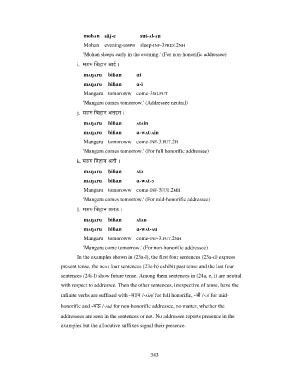
                                 In the examples shown in (23a-l), the first four sentences (23a-d) express

                           present tense, the next four sentences (23e-h) exhibit past tense and the last four
                           sentences (24i-l) show future tense. Among them sentences in (24a, e, i) are neutral

                           with respect to addressee. Then the other sentences, irrespective of tense, have the
                           infinite verbs are suffixed with -अइन /-ʌin/ for full honorific, -औ /-ɔ/ for mid-

                           honorific and -अऊ /-ʌu/ for non-honorific addressee, no matter, whether the

                           addressees are seen in the sentences or not. No addressee reports presence in the
                           examples but the allocutive suffixes signal their presence.


                                                                343

