


Page 369 - A GRAMMAR OF BHOJPURI _ PhD Dissertation 2020 TU
P. 369
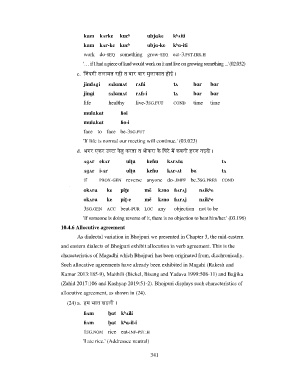
kɑm kʌrke kucʰ ubjɑke kʰʌiti
kɑm kʌr-ke kucʰ ubjɑ-ke kʰɑ-iti
work do-SEQ something grow-SEQ eat-3.PST.IRR.H
'
if I had a piece of land would work on it and live on growing something ...' (02.032)
c. Zजदगी सलामत रही त बार बार मुलाकात होई ।
jindʌɡi sʌlɑmʌt rʌɦi tʌ bɑr bɑr
jinɡi sʌlɑmʌt rʌɦ-i tʌ bɑr bɑr
life healthy live-3SG.FUT COND time time
mulɑkɑt ɦoi
mulɑkɑt ɦo-i
face to face be-3SG.FUT
'If life is normal our meeting will continue.' (03.023)
d. अगर एकर उqटा केi करता त ओकरा के िपटे म& कवनो हरज नइखे ।
ʌɡʌr ekʌr ulʈɑ keɦu kʌrʌtɑ tʌ
ʌɡʌr i-ʌr ulʈɑ keɦu kʌr-ʌt bɑ tʌ
if PROX-GEN reverse anyone do-.IMPF be.3SG.PRES COND
s
okʌrɑ ke piʈe mẽ kɔno ɦʌrʌj nʌikʰe
okʌrɑ ke piʈ-e mẽ kɔno ɦʌrʌj nʌikʰe
3SG.GEN ACC beat-PUR LOC any objection not to be
'If someone is doing reverse of it, there is no objection to beat him/her.' (03.196)
10.4.6 Allocutive agreement
As dialectal variation in Bhojpuri we presented in Chapter 3, the mid-eastern
and eastern dialects of Bhojpuri exhibit allocution in verb agreement. This is the
characteristics of Magadhi which Bhojpuri has been originated from, diachronically.
Such allocative agreements have already been exhibited in Magahi (Rakesh and
Kumar 2013:185-9), Maithili (Bickel, Bisang and Yadava 1999:508-11) and Bajjika
(Zahid 2017:106 and Kashyap 2019:51-2). Bhojpuri displays such characteristics of
allocutive agreement, as shown in (24).
(24) a. हम भात खइली ।
ɦʌm b ̤ ɑt kʰʌili
ɦʌm b ̤ ɑt kʰɑ-il-i
1SG.NOM rice eat-INF-PST.H
'I ate rice.' (Addressee neutral)
341

