


Page 211 - A GRAMMAR OF BHOJPURI _ PhD Dissertation 2020 TU
P. 211
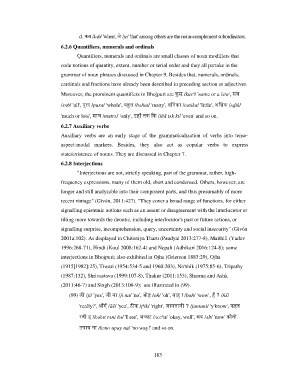
d. कब /kʌb/ 'when', जे /je/ 'that' among others are the noun-complement subordinators.

                           6.2.6 Quantifiers, numerals and ordinals
                                 Quantifiers, numerals and ordinals are small classes of noun modifiers that
                           code notions of quantity, extent, number or serial order and they all partake in the

                           grammar of noun phrases discussed in Chapter 9. Besides that, numerals, ordinals,
                           cardinals and fractions have already been described in preceding section as adjectives.

                           Moreover, the prominent quantifiers in Bhojpuri are कुछ /kucʰ/ 'some or a few', सब

                           /sʌb/ 'all', पूरा /purɑ/ 'whole', बzत /bʌɦut/ 'many', तिनका /tʌnikɑ/ 'little', अिधक /ʌd ̤ ik/

                                                                      ̃
                           'much or lots', माP /mɑtrʌ/ 'only', इहाँ तक 6क /iɦɑ tʌk ki/ 'even' and so on.
                           6.2.7 Auxiliary verbs

                           Auxiliary  verbs  are  an  early  stage  of  the  grammaticalization  of  verbs  into  tense-
                           aspect-modal  markers.  Besides,  they  also  act  as  copular  verbs  to  express

                           state/existence of nouns. They are discussed in Chapter 7.
                           6.2.8 Interjections
                                 "Interjections are not, strictly speaking, part of the grammar, rather, high-

                           frequency expressions, many of them old, short and condensed. Others, however, are
                           longer and still analyzable into their component parts, and thus presumably of more

                           recent vintage" (Givón, 2011:427). "They cover a broad range of functions, for either
                           signalling epistemic notions such as an assent or disagreement with the interlocutor or

                           tilting more towards the deontic, including interlocutor's past or future actions, or
                           signalling surprise, incomprehension, query, uncertainty and social insecurity" (Givόn

                           2001a:102). As displayed in Chitoniya Tharu (Paudyal 2013:277-8), Maithili (Yadav
                           1996:268-71), Hindi (Koul 2008:162-4) and Nepali (Adhikari 2016:124-8); some
                           interjections in Bhojpuri; also exhibited in Ojha (Grierson 1883:29), Ojha

                           (1915[1982]:25), Tiwari (1954:534-5 and 1960:203), Nirbhik (1975:85-6), Tripathy
                           (1987:132), Shrivastava (1999:107-8), Thakur (2011:153), Sharma and Ashk

                           (2011:46-7) and Singh (2013:108-9);  are illustrated in (99).
                              (99) जी /ji/ 'yes', जी ना /ji nɑ/ 'no', ओह /oɦ/ 'oh', बाह ! /bɑɦ/ 'wow', हँ ? /ɦʌ/
                                                                                                ̃
                                  'really?',  आँएँ /ɑẽ/ 'yea', ठीक /ʈʰik/ 'right', जानतानी ? /jɑntɑni/ 'y'know', कहत
                                                ̃
                                  रनी ह /kʌɦʌt rʌni ɦʌ/ 'I see', अSछा /ʌccʰɑ/ 'okay, well', अब /ʌb/ 'now' कौनो

                                  उपाय ना /kɔno upɑy nɑ/ 'no way!' and so on.


                                                                    183

