


Page 208 - A GRAMMAR OF BHOJPURI _ PhD Dissertation 2020 TU
P. 208
'The boy walked having said.'
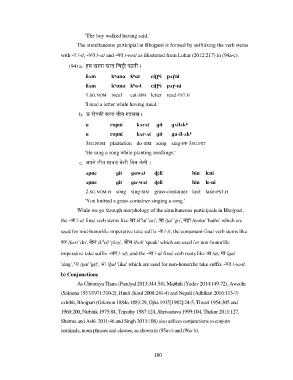
The simultaneous participial in Bhojpuri is formed by suffuixing the verb stems
with -त /-t/, -अत /-ʌt/ and -वत /-wʌt/ as illustrated from Lohar (2012:217) in (94a-c).
(94) a. हम खाना खात िचiी पढ़नी ।
ɦʌm kʰɑnɑ kʰɑt ciʈʈʰi pʌɽ ̊ ni
ɦʌm kʰɑnɑ kʰɑ-t ciʈʈʰi pʌɽ ̊ -ni
1.SG.NOM meal eat-SIM letter read-PST.H
'I read a letter while having meal.'
b. ऊ रोपनी करत गीत गइलख ।
u ropni kʌrʌt ɡit ɡʌilʌkʰ
u ropni kʌr-ʌt ɡit ɡɑ-il-ʌkʰ
3SG.NOM plantation do-SIM song sing-PP-3SG.PST
'He sang a song while planting seedlings.'
c. अपने गीत गावत डेली िबन लेनी ।
ʌpne ɡit ɡɑwʌt ɖeli bin leni
ʌpne ɡit ɡɑ-wʌt ɖeli bin le-ni
2.SG.NOM.H song sing-SIM grass-container knit take-PST.H
'You knitted a grass-container singing a song.'
While we go through morphology of the simultaneous participials in Bhojpuri,
the -आ /-a/ final verb stems like खा /kɑ/ 'eat', जा /jɑ/ 'go', नहा /nʌɦɑ/ 'bathe' which are
used for mid-honorific imperative take suffix -त /-t/; the consonant-final verb stems like
कर /kʌr/ 'do', खेल /kel/ 'play', बोल /bol/ 'speak' which are used for non-honorific
imperative take suffix -अत /-ʌt/; and the -आ /-a/ final verb roots like आ /ɑ/, गा /ɡɑ/
'sing', पा /pɑ/ 'get', भा /b ̤ ɑ/ 'like' which are used for non-honorific take suffix -वत /-wʌt/.
b) Conjunctions
As Chitoniya Tharu (Paudyal 2013:344-54), Maithili (Yadav 2014:149-72), Awadhi
(Saksena 1937/1971:310-2), Hindi (Koul 2008:241-4) and Nepali (Adhikari 2016:113-7)
exhibit, Bhojpuri (Grierson 1884a:1883:29, Ojha 1915[1982]:24-5, Tiwari 1954:305 and
1960:200, Nirbhik 1975:84, Tripathy 1987:124, Shrivastava 1999:104, Thakur 2011:127,
Sharma and Ashk 2011:46 and Singh 2013:108) also utilizes conjunctions to conjoin
nominals, noun phrases and clauses, as shown in (95a-c) and (96a-b).
180

