


Page 179 - A GRAMMAR OF BHOJPURI _ PhD Dissertation 2020 TU
P. 179
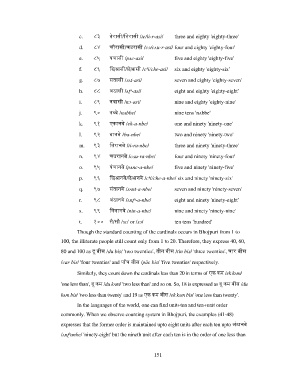
c.    ८३     तेरासी/ितरासी /te/ti-r-ɑsi/   three and eighty 'eighty-three'

                                  d.    ८४     चौरासी/चउरासी /cɔ/cʌu-r-ɑsi/ four and eighty 'eighty-four'

                                  e.    ८५     पचासी /pʌc-ɑsi/            five and eighty 'eighty-five'

                                  f.    ८६     िछआसी/छेआसी /cʰi/che-ɑsi/  six and eighty 'eighty-six'
                                  g.    ८७     सतासी /sʌt-ɑsi/            seven and eighty 'eighty-seven'

                                  h.    ८८     अठासी /ʌʈʰ-ɑsi/            eight and eighty 'eighty-eight'

                                  i.    ८९     नवासी /nɔ-ɑsi/             nine and eighty 'eighty-nine'

                                  j.    ९०     नlबे /nʌbbe/               nine tens 'nʌbbe'

                                  k.    ९१     एकानबे /ek-ɑ-nbe/          one and ninety 'ninety-one'
                                  l.    ९२     बानबे /bɑ-nbe/             two and ninety 'ninety-two'

                                  m.    ९३     ितरानबे /ti-rɑ-nbe/        three and ninety 'ninety-three'

                                  n.    ९४     चउरानबे /cʌu-rɑ-nbe/       four and ninety 'ninety-four'

                                  o.    ९५     पंचानबे /pʌnc-ɑ-nbe/       five and ninety 'ninety-five'

                                  p.    ९६     िछआनबे/छेआनबे /cʰi/che-ɑ-nbe/ six and ninety 'ninety-six'

                                  q.    ९७     संतानबे /sʌnt-ɑ-nbe/       seven and ninety 'ninety-seven'

                                  r.    ९८     अंठानबे /ʌnʈʰ-ɑ-nbe/       eight and ninety 'ninety-eight'
                                  s.    ९९     िननानबे /nin-ɑ-nbe/        nine and ninety 'ninety-nine'

                                  t.    १००  सै/सौ /sɛ/ or /sɔ/           ten tens 'hundred'

                                 Though the standard counting of the cardinals occurs in Bhojpuri from 1 to
                           100, the illiterate people still count only from 1 to 20. Therefore, they express 40, 60,
                           80 and 100 as दू बीस /du bis/ 'two twenties', तीन बीस /tin bis/ 'three twenties', चार बीस


                           /cɑr bis/ 'four twenties' and पाँच बीस /pɑc bis/ 'five twenties' respectively.
                                                               ̃
                                 Similarly, they count down the cardinals less than 20 in terms of एक कम /ek kʌm/

                           'one less than', दू कम /du kʌm/ 'two less than' and so on. So, 18 is expressed as दू कम बीस /du
                           kʌm bis/ 'two less than twenty' and 19 as एक कम बीस /ek kʌm bis/ 'one less than twenty'.

                                 In the languages of the world, one can find unit+ten and ten+unit order
                           commonly. When we observe counting system in Bhojpuri, the examples (41-48)

                           expresses that the former order is maintained upto eight units after each ten upto अंठानबे

                           /ʌnʈʰɑnbe/ 'ninety-eight' but the nineth unit after each ten is in the order of one less than


                                                                    151

