


Page 175 - A GRAMMAR OF BHOJPURI _ PhD Dissertation 2020 TU
P. 175
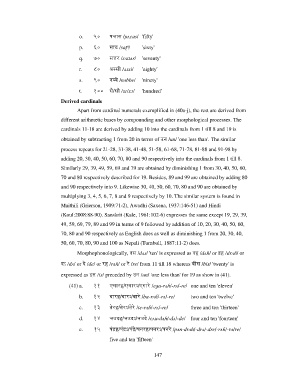
o.    ५०     पचास /pʌcɑs/  'fifty'

                                  p.    ६०     साठ /sɑʈʰ/   'sixty'

                                  q.    ७०     स#र /sʌttʌr/  'seventy'

                                  r.    ८०     अXसी /ʌssi/   'eighty'
                                  s.    ९०     नlबे /nʌbbe/  'ninety'

                                  t.    १००  सै/सौ /sɛ/sɔ/   'hundred'

                           Derived cardinals
                                 Apart from cardinal numerals exemplified in (40a-j), the rest are derived from

                           different arithmetic bases by compounding and other morphological processes. The
                           cardinals 11-18 are derived by adding 10 into the cardinals from 1 till 8 and 19 is

                           obtained by subtracting 1 from 20 in terms of उन /un/ 'one less than'. The similar
                           process repeats for 21-28, 31-38, 41-48, 51-58, 61-68, 71-78, 81-88 and 91-98 by

                           adding 20, 30, 40, 50, 60, 70, 80 and 90 respectively into the cardinals from 1 till 8.
                           Similarly 29, 39, 49, 59, 69 and 79 are obtained by diminishing 1 from 30, 40, 50, 60,

                           70 and 80 respectively described for 19. Besides, 89 and 99 are obtained by adding 80
                           and 90 respectively into 9. Likewise 30, 40, 50, 60, 70, 80 and 90 are obtained by

                           multiplying 3, 4, 5, 6, 7, 8 and 9 respectively by 10. The similar system is found in
                           Maithili (Grierson, 1909:71-2), Awadhi (Saxena, 1937:146-51) and Hindi

                           (Koul:2008:88-90). Sanskrit (Kale, 1961:102-6) expresses the same except 19, 29, 39,
                           49, 59, 69, 79, 89 and 99 in terms of 9 followed by addition of 10, 20, 30, 40, 50, 60,
                           70, 80 and 90 respectively as English does as well as diminishing 1 from 20, 30, 40,

                           50, 60, 70, 80, 90 and 100 as Nepali (Turnbull, 1887:11-2) does.
                                 Morphophonologically, दस /dʌs/ 'ten' is expressed as दह /dʌɦ/ or mह /drʌɦ/ or

                           दऽ /dʌ/ or दे /de/ or रह /rʌɦ/ or रे /re/ from 11 till 18 whereas बीस /bis/ 'twenty' is

                           expressed as इस /is/ preceded by उन /un/ 'one less than' for 19 as show in (41).

                              (41) a.   ११     एगारह/एगारऽ/एगारे /eɡɑ-rʌɦ/-rʌ/-re/  one and ten 'eleven'

                                  b.    १२     बारह/बारऽ/बारे /bɑ-rʌɦ/-rʌ/-re/   two and ten 'twelve'

                                  c.    १३     तेरह/तेरऽ/तेरे /te-rʌɦ/-rʌ/-re/     three and ten 'thirteen'
                                  d.    १४     चउदह/चउदऽ/चउदे /cʌu-dʌɦ/-dʌ/-de/  four and ten 'fourteen'

                                  e.        १५   पंmह/प ंmऽ/पंmे/पनरह/पनरऽ/पनरे /pʌn-drʌh/-drʌ/-dre/-rʌɦ/-rʌ/re/

                                               five and ten 'fifteen'


                                                                    147

