


Page 35 - Bhojpuri Verb Morphology
P. 35
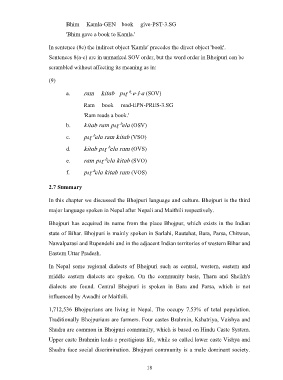
Bhim Kamla-GEN book give-PST-3.SG
'Bhim gave a book to Kamla.'
In sentence (8c) the indirect object 'Kamla' precedes the direct object 'book'.
Sentences 8(a-c) are in unmarked SOV order, but the word order in Bhojpuri can be
scrambled without affecting its meaning as in:
(9)
a. ---(SOV)
Ram book read-EPN-PRES-3.SG
'Ram reads a book.'
b. (OSV)
c (VSO)
d. (OVS)
e (SVO)
f. (VOS)
2.7 Summary
In this chapter we discussed the Bhojpuri language and culture. Bhojpuri is the third
major language spoken in Nepal after Nepali and Maithili respectively.
Bhojpuri has acquired its name from the place Bhojpur, which exists in the Indian
state of Bihar. Bhojpuri is mainly spoken in Sarlahi, Rautahat, Bara, Parsa, Chitwan,
Nawalparasi and Rupendehi and in the adjacent Indian territories of western Bihar and
Eastern Uttar Pradesh.
In Nepal some regional dialects of Bhojpuri such as central, western, eastern and
middle eastern dialects are spoken. On the community basis, Tharu and Sheikh's
dialects are found. Central Bhojpuri is spoken in Bara and Parsa, which is not
influenced by Awadhi or Maithili.
1,712,536 Bhojpurians are living in Nepal. The occupy 7.53% of total population.
Traditionally Bhojpurians are farmers. Four castes Brahmin, Kshatriya, Vaishya and
Shudra are common in Bhojpuri community, which is based on Hindu Caste System.
Upper caste Brahmin leads a prestigious life, while so called lower caste Vishya and
Shudra face social discrimination. Bhojpuri community is a male dominant society.
18

