


Page 104 - Bhojpuri Verb Morphology
P. 104
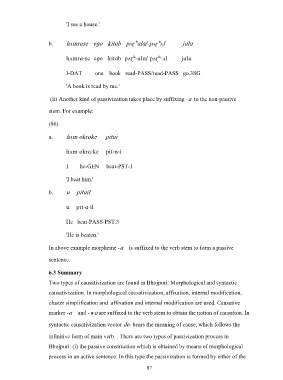
'I see a house.'
b. /
--/-
I-DAT one book read-PASS/read-PASS go.3SG
'A book is read by me.'
(ii) Another kind of passivization takes place by suffixing - to the non-passive
stem. For example:
(86)
a.
---
I he-GEN beat-PST-1
'I beat him.'
b.
--
He beat-PASS-PST.3
'He is beaten.'
In above example morpheme - is suffixed to the verb stem to form a passive
sentence.
6.3 Summary
Two types of causativization are found in Bhojpuri: Morphological and syntactic
causativization. In morphological causativization, affixation, internal modification,
cluster simplification and affixation and internal modification are used. Causative
marker - and - are suffixed to the verb stem to obtain the notion of causation. In
syntactic causativization vector - bears the meaning of cause, which follows the
infinitive form of main verb. . There are two types of passivization process in
Bhojpuri: (i) the passive construction which is obtained by means of morphological
process in an active sentence. In this type the passivization is formed by either of the
87

