


Page 55 - A GRAMMAR OF BHOJPURI _ PhD Dissertation 2020 TU
P. 55
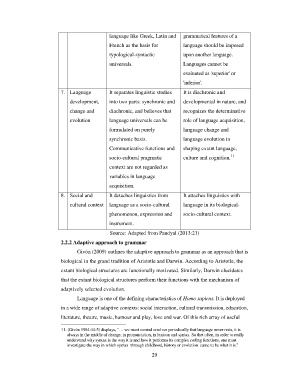
language like Greek, Latin and grammatical features of a
French as the basis for language should be imposed
typological-syntactic upon another language.
universals. Languages cannot be
evaluated as 'superior' or
'inferior'.
7. Language It separates linguistic studies It is diachronic and
development, into two parts: synchronic and developmental in nature, and
change and diachronic, and believes that recognizes the determinative
evolution language universals can be role of language acquisition,
formulated on purely language change and
synchronic basis. language evolution in
Communicative functions and shaping extant language,
11
socio-cultural pragmatic culture and cognition.
context are not regarded as
variables in language
acquisition.
8. Social and It detaches linguistics from It attaches linguistics with
cultural context language as a socio-cultural language in its biological-
phenomenon, expression and socio-cultural context.
instrument.
Source: Adapted from Paudyal (2013:21)
2.2.2 Adaptive approach to grammar
Givón (2009) outlines the adaptive approach to grammar as an approach that is
biological in the grand tradition of Aristotle and Darwin. According to Aristotle, the
extant biological structures are functionally motivated. Similarly, Darwin elucidates
that the extant biological structures perform their functions with the mechanism of
adaptively selected evolution.
Language is one of the defining characteristics of Homo sapiens. It is deployed
in a wide range of adaptive contexts: social interaction, cultural transmission, education,
literature, theatre, music, humour and play, love and war. Of this rich array of useful
11. (Givón 1984:44-5) displays, "
we must remind orselves periodically that language never rests, it is
always in the middle of change, in pronunciation, in lexicon and syntax. So thet often, in order to really
understand why syntax is the way it is and how it performs its complex coding functions, one must
investigate the way in which syntaxthrough childhood, history or evolutioncame to be what it is."
29

