


Page 56 - A GRAMMAR OF BHOJPURI _ PhD Dissertation 2020 TU
P. 56
applications, two core adaptive functions make all the rest possible: mental
representation and communication of information (Givón, 2009:19).
Mental representation is the individual mental affair to code, make sense of,
interpret and construct 'reality', be it external, mental or social. On the other hand
communication is chiefly an interactive affair of two (or more) minds exchanging
mentally-represented information; or, as is often the case, negotiating and
constructing it jointly. Of these two core functions of language, as one can represent
information in the mind/brain, mental representation is ontogenetically and phylo-
genetically older, often automatically and sub-consciously, without intending to
communicate it, but, nobody can intentionally communicate information that is not
first represented in the mind.
As Givón (2009:21-2) quotes Geary (2005), Cheyney and Seyfarth (2007),
Carter (1974) and Givón (2002a, ch. 4,5) as mentioning overwhelming evidence from
animal communication, child language development and neurology that cognitive
representation preceded communication in evolution, whereas, representation and
communication are the two core adaptive functions of human language and it can be
taken for granted that cognitive representation is present in pre-human species, and is
a development pre-requisite to language. There are two specific communicative codes
phonology and grammar that human communication added to the pre-existing
cognitive representation system.
Atkinson and Shiffrin (1968) counts three major systems of mental
representation in the human mind/brain recognized by cognitive scientists long
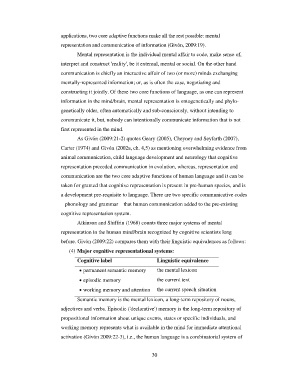
before. Givón (2009:22) compares them with their linguistic equivalences as follows:
(4) Major cognitive representational systems:
Cognitive label Linguistic equivalence
permanent semantic memory the mental lexicon
episodic memory the current text
working memory and attention the current speech situation
Semantic memory is the mental lexicon, a long-term repository of nouns,
adjectives and verbs. Episodic ('declarative') memory is the long-term repository of
propositional information about unique events, states or specific individuals, and
working memory represents what is available in the mind for immediate attentional
activation (Givón 2009:22-3), i.e., the human language is a combinatorial system of
30

