


Page 57 - A GRAMMAR OF BHOJPURI _ PhD Dissertation 2020 TU
P. 57
the three labels in terms of lexicons (words), propositions (clauses) and multi-
propositional discourse (coherence) to support human communication.
Givón (2009:28) states that the adaptive function of grammar comes into sharp
relief what one notes that humans can, in some developmental, social or neurological
contexts, communicate without grammar, i.e., the pre-grammatical pidgin
communication." It clearly reveals that grammar is an adaptive human phenomenon as
the structural and functional differences between pre-grammatical and grammatical
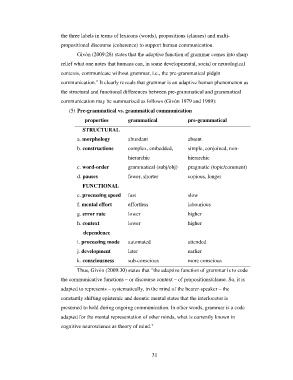
communication may be summarized as follows (Givón 1979 and 1989):
(5) Pre-grammatical vs. grammatical communication
properties grammatical pre-grammatical
STRUCTURAL
a. morphology abundant absent
b. constructions complex, embedded, simple, conjoined, non-
hierarchic hierarchic
c. word-order grammatical (subj/obj) pragmatic (topic/comment)
d. pauses fewer, shorter copious, longer
FUNCTIONAL
e. processing speed fast slow
f. mental effort effortless labourious
g. error rate lower higher
h. context lower higher
dependence
i. processing mode automated attended
j. development later earlier
k. consciousness sub-conscious more conscious
Thus, Givón (2009:30) states that "the adaptive function of grammar is to code
the communicative functions or discourse context of propositions/clause. So, it is
adapted to represents systematically, in the mind of the hearer-speaker the
constantly shifting epistemic and deontic mental states that the interlocutor is
presumed to hold during ongoing communication. In other words, grammar is a code
adapted for the mental representation of other minds, what is currently known in
cognitive neuroscience as theory of mind."
31

