


Page 54 - A GRAMMAR OF BHOJPURI _ PhD Dissertation 2020 TU
P. 54
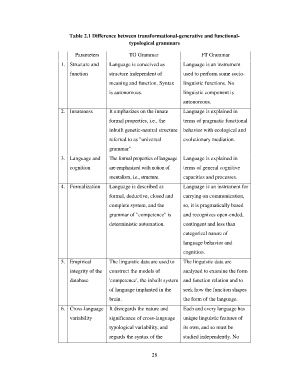
Table 2.1 Difference between transformational-generative and functional-
                                                       typological grammars

                                Parameters             TG Grammar                    FT Grammar
                           1.  Structure and   Language is conceived as       Language is an instrument

                              function         structure independent of       used to perform some socio-
                                               meaning and function. Syntax   linguistic functions. No

                                               is autonomous.                 linguistic component is
                                                                              autonomous.
                           2.  Innateness      It emphasizes on the innate    Language is explained in

                                               formal properties, i.e., the   terms of pragmatic functional
                                               inbuilt genetic-neutral structure  behavior with ecological and

                                               referred to as "universal      evolutionary mediation.
                                               grammar"

                           3.  Language and    The formal properties of language  Language is explained in
                              cognition        are emphasized with notion of   terms of general cognitive

                                               mentalism, i.e., structure.    capacities and processes.
                           4.  Formalization   Language is described as       Language is an instrument for
                                               formal, deductive, closed and   carrying on communication,

                                               complete system, and the       so, it is pragmatically based
                                               grammar of "competence" is     and recognizes open-ended,

                                               deterministic automation.      contingent and less than
                                                                              categorical nature of

                                                                              language behavior and
                                                                              cognition.

                           5.  Empirical       The linguistic data are used to   The linguistic data are
                              integrity of the   construct the models of      analyzed to examine the form
                              database         'competence', the inbuilt system  and function relation and to

                                               of language implanted in the   seek how the function shapes
                                               brain.                         the form of the language.

                           6.  Cross-language  It disregards the nature and   Each and every language has
                              variability      significance of cross-language   unique linguistic features of

                                               typological variability, and   its own, and so must be
                                               regards the syntax of the      studied independently. No


                                                                28

