


Page 50 - A GRAMMAR OF BHOJPURI _ PhD Dissertation 2020 TU
P. 50
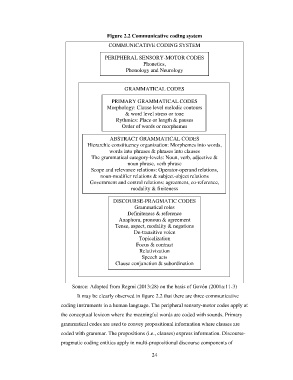
Figure 2.2 Communicative coding system
                                              COMMUNICATIVE CODING SYSTEM

                                              PERIPHERAL SENSORY-MOTOR CODES
                                                             Phonetics,
                                                      Phonology and Neurology


                                                     GRAMMATICAL CODES

                                                PRIMARY GRAMMATICAL CODES
                                              Morphology: Clause level melodic contours
                                                     & word level stress or tone
                                                 Rythmics: Place or length & pauses
                                                    Order of words or morphemes

                                               ABSTRACT GRAMMATICAL CODES
                                      Hierarchic constituency organization: Morphemes into words,
                                               words into phrases & phrases into clauses
                                       The grammatical category-levels: Noun, verb, adjective &
                                                      noun phrase, verb phrase
                                       Scope and relevance relations: Operator-operand relations,
                                           noun-modifier relations & subject-object relations
                                       Government and control relations: agreement, co-reference,
                                                        modality & finiteness

                                                   DISCOURSE-PRAGMATIC CODES
                                                         Grammatical roles
                                                      Definiteness & reference
                                                   Anaphora, pronoun & agreement
                                                 Tense, aspect, modality & negations
                                                         De-transitive voice
                                                           Topicalization
                                                          Focus & contrast
                                                           Relativization
                                                            Speech acts
                                                 Clause conjunction & subordination


                               Source: Adapted from Regmi (2013:28) on the basis of Govón (2001a:11-3)

                                 It may be clearly observed in figure 2.2 that there are three communicative
                           coding instruments in a human language. The peripheral sensory-motor codes apply at

                           the conceptual lexicon where the meaningful words are coded with sounds. Primary
                           grammatical codes are used to convey propositional information where clauses are
                           coded with grammar. The propositions (i.e., clauses) express information. Discourse-

                           pragmatic coding entities apply in multi-propositional discourse components of

                                                                24

