


Page 46 - A GRAMMAR OF BHOJPURI _ PhD Dissertation 2020 TU
P. 46
(a) The cognitive representation system
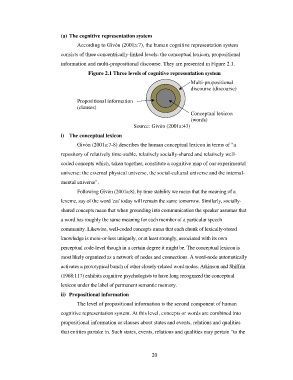
                                 According to Givón (2001a:7), the human cognitive representation system

                           consists of three concentrically-linked levels: the conceptual lexicon, propositional
                           information and multi-propositional discourse. They are presented in Figure 2.1.

                                      Figure 2.1 Three levels of cognitive representation system
                                                                                 Multi-propositional
                                                                                 discourse (discourse)

                                 Propositional information
                                 (clauses)
                                                                                 Conceptual lexicon
                                                                                 (words)
                                                              Source: Givón (2001a:43)

                           i)  The conceptual lexicon
                                 Givón (2001a:7-8) describes the human conceptual lexicon in terms of "a

                           repository of relatively time-stable, relatively socially-shared and relatively well-
                           coded concepts which, taken together, constitute a cognitive map of our experimental
                           universe: the external physical universe, the social-cultural universe and the internal-

                           mental universe".
                                 Following Givón (2001a:8), by time stability we mean that the meaning of a

                           lexeme, say of the word 'cat' today will remain the same tomorrow. Similarly, socially-
                           shared concepts mean that when grounding into communication the speaker assumes that

                           a word has roughly the same meaning for each member of a particular speech
                           community. Likewise, well-coded concepts mean that each chunk of lexically-stored

                           knowledge is more-or-less uniquely, or at least strongly, associated with its own
                           perceptual code-level though in a certain degree it might be. The conceptual lexicon is
                           most likely organized as a network of nodes and connections. A word-node automatically

                           activates a prototypical bunch of other closely-related word nodes. Atkinson and Shiffrin
                           (1968:117) exhibits cognitive psychologists to have long recognized the conceptual

                           lexicon under the label of permanent semantic memory.
                           ii)  Propositional information

                                 The level of propositional information is the second component of human
                           cognitive representation system. At this level, concepts or words are combined into

                           propositional information or clauses about states and events, relations and qualities
                           that entities partake in. Such states, events, relations and qualities may pertain "to the


                                                                20

