


Page 432 - A GRAMMAR OF BHOJPURI _ PhD Dissertation 2020 TU
P. 432
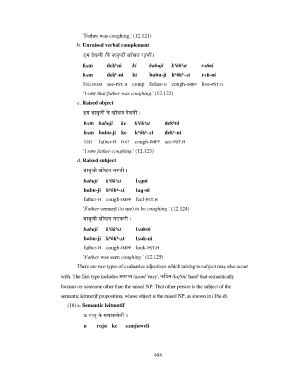
'Father was coughing.' (12.121)
                                 b. Unraised verbal complement

                                    हम देखनी 'क बाबुजी खMखत रहनी ।
                                    ɦʌm       dekʰni    ki     bɑbuji    kʰõkʰʌt     rʌɦni

                                    ɦʌm       dekʰ-ni   ki     bɑbu-ji  kʰõkʰ-ʌt     rʌɦ-ni
                                    1SG.NOM  see-PST.H  comp  father-H  cough-IMPF  live-PST.H

                                    'I saw that father was coughing.' (12.122)
                                 c. Raised object

                                    हम बाबुजी के खsखत देखनी ।

                                    ɦʌm  bɑbuji     ke   kʰõkʰʌt      dekʰni
                                    ɦʌm  bɑbu-ji  ke     kʰõkʰ-ʌt     dekʰ-ni
                                    1SG   father-H  DAT  cough-IMPF  see-PST.H

                                    'I saw father coughing.' (12.123)
                                 d. Raised subject

                                    बाबुजी खsखत लगनी ।

                                    bɑbuji   kʰõkʰʌt      lʌɡni
                                    bɑbu-ji  kʰõkʰ-ʌt     lɑɡ-ni
                                    father-H  cough-IMPF  feel-PST.H

                                    'Father seemed (to me) to be coughing.' (12.124)
                                    बाबुजी खsखत लउकनी ।

                                    bɑbuji   kʰõkʰʌt      lʌukni

                                    bɑbu-ji  kʰõkʰ-ʌt     lʌuk-ni
                                    father-H  cough-IMPF  look-PST.H
                                    'Father was seen coughing.' (12.125)

                                 There are two types of evaluative adjectives which raising to subject may also occur

                           with. The first type includes आसान /ɑsɑn/ 'easy', कcठन /kʌʈʰin/ 'hard' that semantically
                           focuses on someone other than the raised NP. That other person is the subject of the

                           semantic leitmotif proposition, whose object is the raised NP, as shown in (18a-d).
                             (18) a. Semantic leitmotif

                                    ऊ राजु के समझावेली ।
                                    u    rɑju  ke     sʌmȷ ̈ ɑweli


                                                                    404

