


Page 25 - Bhojpuri Verb Morphology
P. 25
The 7.42% of the whole population and 98.51% of the Bhojpuria population live at

                    their native places and others as migrants in Nepalese territories.

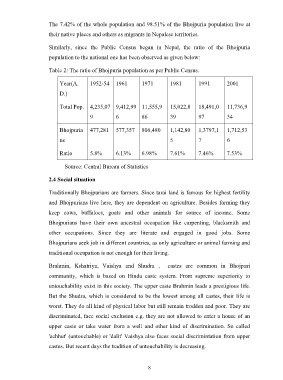
                    Similarly,  since  the  Public  Census  began  in  Nepal,  the  ratio  of  the  Bhojpuria
                    population to the national one has been observed as given below:

                    Table 2: The ratio of Bhojpuria population as per Public Census.

                        Year(A.     1952-54  1961       1971       1981       1991       2001

                        D.)

                        Total Pop.  4,235,07 9,412,99 11,555,9     15,022,8   18,491,0   11,736,9

                                    9         6         86         39         97         34

                        Bhojpuria   477,281  577,357  806,480      1,142,80   1,3797,1   1,712,53
                        ns                                         5          7          6

                        Ratio       5.8%      6.13%     6.98%      7.61%      7.46%      7.53%


                          Source: Central Bureau of Statistics

                    2.4 Social situation

                    Traditionally Bhojpurians are farmers. Since tarai land is famous for highest fertility
                    and Bhojpurians live here, they are dependent on agriculture. Besides farming they

                    keep  cows,  buffaloes,  goats  and  other  animals  for  source  of  income.  Some
                    Bhojpurians  have  their  own  ancestral  occupation  like  carpenting,  blacksmith  and

                    other  occupations.  Since  they  are  literate  and  engaged  in  good  jobs.  Some
                    Bhojpurians seek job in different countries, as only agriculture or animal farming and
                    traditional occupation is not enough for their living.


                    Brahmin,  Kshatriya,  Vaishya  and  Shudra  ,    castes  are  common  in  Bhojpuri
                    community,  which  is  based  on  Hindu  caste  system.  From  supreme  superiority  to
                    untouchability exist in this society. The upper caste Brahmin leads a prestigious life.

                    But the Shudra, which is considered to be the lowest among all castes, their life is
                    worst. They do all kind of physical labor but still remain trodden and poor. They are

                    discriminated, face social exclusion e.g. they are not allowed to enter a house of an
                    upper  caste  or  take  water  from  a  well  and  other  kind  of  discrimination.  So  called

                    'achhut' (untouchable) or 'dalit' Vaishya also faces social discrimintation from upper
                    castes. But recent days the tradition of untouchability is decreasing.


                                                           8

