


Page 312 - A GRAMMAR OF BHOJPURI _ PhD Dissertation 2020 TU
P. 312
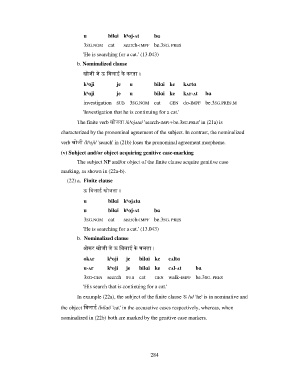
u         bilɑi  kʰoj-ʌt     bɑ
                                    3SG.NOM  cat     search-IMPF  be.3SG. PRES

                                    'He is searching for a cat.' (13.043)
                                 b. Nominalized clause

                                    खोजी जे ऊ िबलाई के करता ।
                                    kʰoji         je   u         bilɑi  ke    kʌrtɑ

                                    kʰoji         je   u         bilɑi  ke    kʌr-ʌt   bɑ
                                    investigation  SUB  3SG.NOM  cat    GEN  do-IMPF  be.3SG.PRES.M

                                    'Investigation that he is continuing for a cat.'
                                 The finite verb खोजता /kʰojʌtɑ/ 'search-IMPF+be.3SG.PRES' in (21a) is

                           characterized by the pronominal agreement of the subject. In contrast, the nominalized

                           verb खोजी /kʰoji/ 'search' in (21b) loses the pronominal agreement morpheme.
                           (v) Subject and/or object acquiring genitive case-marking

                                 The subject NP and/or object of the finite clause acquire genitive case
                           marking, as shown in (22a-b).
                             (22) a.  Finite clause

                                    ऊ िबलाई खोजता ।

                                    u         bilɑi  kʰojʌtɑ
                                    u         bilɑi  kʰoj-ʌt     bɑ

                                    3SG.NOM  cat     search-IMPF  be.3SG. PRES
                                    'He is searching for a cat.' (13.043)

                                 b.  Nominalized clause
                                    ओकर खोजी जे ऊ िबलाई के चलता ।

                                    okʌr      kʰoji   je   bilɑi  ke   cʌltɑ
                                    u-ʌr      kʰoji   je   bilɑi  ke   cʌl-ʌt      bɑ

                                    3SG-GEN  search  SUB  cat     GEN  walk-IMPF  be.3SG. PRES
                                    'His search that is continuing for a cat.'

                                 In example (22a), the subject of the finite clause ऊ /u/ 'he' is in nominative and

                           the object िबलाई /bilɑi/ 'cat' in the accusative cases respectively, whereas, when
                           nominalized in (22b) both are marked by the genitive case markers.


                                                                284

