


Page 308 - A GRAMMAR OF BHOJPURI _ PhD Dissertation 2020 TU
P. 308
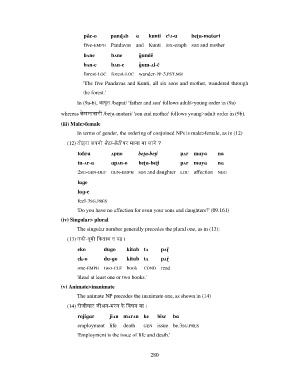
pɑ ̃ c-o   pɑnɖʌb     ɑ    kunti  cʰɔ-u      beʈɑ-mɑtɑri
                                    five-EMPH  Pandavas  and  Kunti  SIX-emph  son and mother

                                    bʌne        bʌne       ɡ ̈ umlẽ
                                    bʌn-e       bʌn-e      ɡ ̈ um-ʌl-ẽ

                                    forest-LOC  forest-LOC  wander-PP-3.PST.MH
                                    'The five Pandavas and Kunti, all six sons and mother, wandered through

                                    the forest.'
                                 In (9a-b), बापूत /bɑput/ 'father and son' follows adult>young order in (9a)

                           whereas बेटामातारी /beʈɑ-mɑtɑri/ 'son and mother' follows young>adult order in (9b).

                           (iii) Male>female
                                 In terms of gender, the ordering of conjoined NPs is male>female, as in (12)

                             (12) तोहरा अपनो बेटा-बेटी पर माया ना लागे ?

                                 toɦrɑ         ʌpno        beʈɑ-beʈi        pʌr  mɑyɑ       nɑ
                                 tu-ʌr-ɑ       ɑpʌn-o      beʈɑ-beʈi        pʌr  mɑyɑ       nɑ
                                 2SG-GEN-DEF  GEN-EMPH  son and daughter  LOC  affection  NEG

                                 lɑɡe
                                 lɑɡ-e

                                 feel-3SG.PRES
                                 'Do you have no affection for even your sons and daughters?' (09.161)

                           (iv) Singular> plural
                                 The singular number generally precedes the plural one, as in (13):

                             (13) एको-दूगो Pकताब त पढ़ ।
                                 eko        duɡo      kitɑb  tʌ     pʌɽ ̊

                                 ek-o       du-ɡo     kitɑb  tʌ     pʌɽ ̊
                                 one-EMPH  two-CLF  book     COND  read

                                 'Read at least one or two books.'
                           (v) Animate>inanimate

                                 The animate NP precedes the inanimate one, as shown in (14)
                             (14) रोजीगार जीअन-मरन के िवषय बा ।

                                 rojiɡɑr       jiʌn  mʌrʌn  ke     bisɛ   bɑ
                                 employment  life    death   GEN  issue  be.3SG.PRES

                                 'Employment is the issue of life and death.'


                                                                280

