


Page 74 - A GRAMMAR OF BHOJPURI _ PhD Dissertation 2020 TU
P. 74
u         ɑm      kʰɑ-it    bɑ       kʰɑ-it    bɑ
                                    3SG.NOM  mango  eat-IMPF  be.PRES  eat-IMPF  be.PRES

                                    'He is eating a mango.'
                                 e. तू आम खाइत बाड़ऽ/खाइताड़ऽ ।

                                    tu            ɑm      kʰɑit    bɑɽʌ
                                    tu            ɑm      kʰɑ-it   bɑɽʌ

                                    2SG.NOM.MH  mango  eat-IMPF  be.PRES.MH

                                    kʰɑitɑɽʌ
                                    kʰɑ-it    bɑɽʌ
                                    eat-IMPF  be.PRES.MH

                                    'You are eating a mango.' (Mid-honorific)
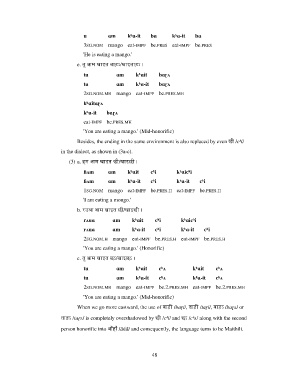
                                 Besides, the ending in the same environment is also replaced by even छी /cʰi/

                           in the dialect, as shown in (3a-c).

                              (3) a. हम आम खाइत छी/खाइछी ।
                                    ɦʌm       ɑm      kʰɑit     cʰi        kʰɑicʰi

                                    ɦʌm       ɑm      kʰɑ-it    cʰi        kʰɑ-it   cʰi
                                    1SG.NOM  mango  eat-IMPF  be.PRES.H  eat-IMPF  be.PRES.H

                                    'I am eating a mongo.'
                                 b. रउआ आम खाइत छी/खाइछी ।

                                    rʌuɑ        ɑm      kʰɑit     cʰi        kʰɑicʰi
                                    rʌuɑ        ɑm      kʰɑ-it    cʰi        kʰɑ-it   cʰi

                                    2SG.NOM.H  mango  eat-IMPF  be.PRES.H  eat-IMPF  be.PRES.H
                                    'You are eating a mango.' (Honorific)

                                 c. तू आम खाइत छऽ/खाइछऽ ।

                                    tu            ɑm      kʰɑit    cʰʌ            kʰɑit    cʰʌ
                                    tu            ɑm      kʰɑ-it   cʰʌ            kʰɑ-it   cʰʌ
                                    2SG.NOM.MH  mango  eat-IMPF  be.2.PRES.MH  eat-IMPF  be.2.PRES.MH

                                    'You are eating a mango.' (Mid-honorific)

                                 When we go more eastward, the use of बाड़ी /bɑɽi/, ताड़ी /tɑɽi/, बाड़ऽ /bɑɽʌ/ or
                           ताड़ऽ /tɑɽʌ/ is completely overshadowed by छी /cʰi/ and छऽ /cʰʌ/ along with the second

                                                    ̃
                                                       ̃
                           person honorific into आँहाँ /ɑɦɑ/ and consequently, the language turns to be Maithili.


                                                                48

