


Page 76 - A GRAMMAR OF BHOJPURI _ PhD Dissertation 2020 TU
P. 76
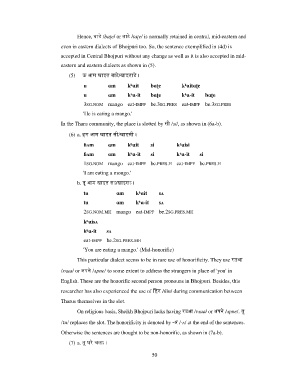
Hence, बाटे /bɑʈe/ or ताटे /tɑʈe/ is normally retained in central, mid-eastern and
even in eastern dialects of Bhojpuri too. So, the sentence exemplified in (4d) is
accepted in Central Bhojpuri without any change as well as it is also accepted in mid-
eastern and eastern dialects as shown in (5).
(5) ऊ आम खाइत बाटे/खाइताटे ।
u ɑm kʰɑit bɑʈe kʰɑitɑʈe
u ɑm kʰɑ-it bɑʈe kʰɑ-it bɑʈe
3SG.NOM mango eat-IMPF be.3SG.PRES eat-IMPF be.3SG.PRES
'He is eating a mango.'
In the Tharu community, the place is slotted by सी /si/, as shown in (6a-b).
(6) a. हम आम खाइत सी/खाइसी ।
ɦʌm ɑm kʰɑit si kʰɑisi
ɦʌm ɑm kʰɑ-it si kʰɑ-it si
1SG.NOM mango eat-IMPF be.PRES.H eat-IMPF be.PRES.H
'I am eating a mongo.'
b. तू आम खाइत सऽ/खाइसऽ ।
tu ɑm kʰɑit sʌ
tu ɑm kʰɑ-it sʌ
2SG.NOM.MH mango eat-IMPF be.2SG.PRES.MH
kʰɑisʌ
kʰɑ-it sʌ
eat-IMPF be.2SG.PRES.MH
'You are eating a mango.' (Mid-honorific)
This particular dialect seems to be in rare use of honorificity. They use रउआ
/rʌuɑ/ or अपने /ʌpne/to some extent to address the strangers in place of 'you' in
English. These are the honorific second person pronouns in Bhojpuri. Besides, this
researcher has also experienced the use of िहन /ɦin/ during communication between
Tharus themselves in the slot.
On religious basis, Sheikh Bhojpuri lacks having रउआ /rʌuɑ/ or अपने /ʌpne/तू
replaces the slot. The honorificity is denoted by -अ /-ʌ/ at the end of the sentences.
Otherwise the sentences are thought to be non-honorific, as shown in (7a-b).
(7) a. तू घरे चलऽ ।
50

