


Page 593 - A GRAMMAR OF BHOJPURI _ PhD Dissertation 2020 TU
P. 593
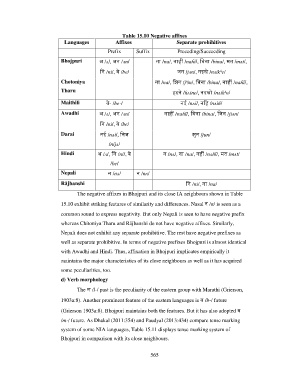
Table 15.10 Negative affixes
                            Languages            Affixes                   Separate probihitives

                                              Prefix      Suffix           Preceding/Succeeding
                           Bhojpuri        अ /ʌ/, अन /ʌn/         ना /nɑ/, नाहS /nɑɦĩ/, िबना /binɑ/, मत /mʌt/,

                                           िन /ni/, बे /be/                जन /jʌn/, नइखे /nʌikʰe/

                           Chotoniya                              ना /nɑ/, िझन /jʰin/, िबना /binɑ/, नाहS /nɑɦĩ/,
                           Tharu
                                                                         हइने /ɦʌine/, नइखो /nʌikʰo/
                           Maithili          बे- /be-/                       नई /nʌi/, निह /nʌiɦ/

                           Awadhi          अ /ʌ/, अन /ʌn/             नाहS /nɑɦĩ/, िबना /binɑ/, िजन /jiʌn/

                                           िन /ni/, बे /be/
                           Darai           नई /nʌi/, िनज                         झुन /ȷ ̈ un/

                                               /nijʌ/

                           Hindi          अ /ʌ/, िन /ni/, बे         न /nʌ/, ना /nɑ/, नहS /nʌɦĩ/, मत /mʌt/
                                               /be/
                           Nepali             न /nʌ/      न /nʌ/

                           Rājbanshi                                           िन /ni/, ना /nɑ/

                                 The negative affixes in Bhojpuri and its close IA neighbours shown in Table

                           15.10 exhibit striking features of similarity and differences. Nasal न /n/ is seen as a
                           common sound to express negativity. But only Nepali is seen to have negative prefix

                           whereas Chitoniya Tharu and Rājbanshi do not have negative affixes. Similarly,
                           Nepali does not exhibit any separate prohibitive. The rest have negative prefixes as
                           well as separate prohibitive. In terms of negative prefixes Bhojpuri is almost identical

                           with Awadhi and Hindi. Thus, affixation in Bhojpuri implicates empirically it
                           maintains the major characteristics of its close neighbours as well as it has acquired

                           some peculiarities, too.
                           d) Verb morphology

                                 The ल /l-/ past is the peculiarity of the eastern group with Marathi (Grierson,

                           1903a:8). Another prominent feature of the eastern languages is ब /b-/ future
                           (Grierson 1903a:8). Bhojpuri maintains both the features. But it has also adopted म

                           /m-/ future. As Dhakal (2011:354) and Paudyal (2013:434) compare tense marking
                           system of some NIA languages, Table 15.11 displays tense marking system of

                           Bhojpuri in comparison with its close neighbours.


                                                                565

