


Page 590 - A GRAMMAR OF BHOJPURI _ PhD Dissertation 2020 TU
P. 590
'people' in honorific environment. Besides, Bhojpuri has particle जा /jɑ/ to mark plural
in clause-final position. Grierson (1903b:2) states, "in Hindi, the oblique form of the
genitive postposition is के /ke/, but in Bhojpuri, the only dialect of Bihari, in which it
has an oblique form का /kɑ/, and this oblique form of the genitive is used to form the
nominative plural, a peculiar construction unknown to Hindi." Thus, the oblique form
हमनीका /ɦʌmnikɑ/ or हमनी के /ɦamni ke/ 'of us' is used to mean 'we' in Bhojpuri. The
typical letter for the genitive case in the eastern group is र /r/ (Grierson, 1903a:8),
also available in Bhojpuri pronouns. Dative-accusative marker in the eastern group is
हे /ɦe/ or के /ke/ (Grierson, 1904:4) maintained in Bhojpuri with a new development of
clitic -ए /-e/. Grierson (1903a:8) records, "the sign for the dative case in Bengali,
Assamese and Bihari is के /ke/", Bhojpuri maintains it. As the case marking system of
Bhojpuri has already been discussed in Chapter 8 and Paudyal (2013:432-3) compares
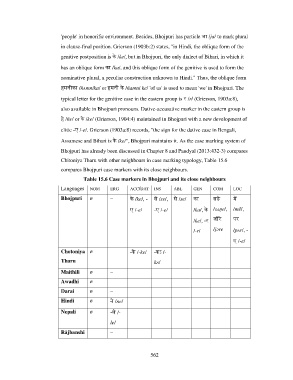
Chitoniya Tharu with other neighbours in case marking typology, Table 15.6
compares Bhojpuri case markers with its close neighbours.
Table 15.6 Case markers in Bhojpuri and its close neighbours
Languages NOM ERG ACC/DAT INS ABL GEN COM LOC
Bhojpuri ø के /ke/, - से /se/, से /se/ का सङे मR
ए /-e/ -ए /-e/ /kɑ/, के /sʌŋe/, /mẽ/,
/ke/, -र जौरे पर
/-r/ /jɔre /pʌr/, -
ए /-e/
Chotoniya ø -के /-ke/ -कऽ /-
Tharu kʌ/
Maithili ø
Awadhi ø
Darai ø
Hindi ø ने /ne/
Nepali ø -ले /-
le/
Rājbanshi
562

