


Page 484 - A GRAMMAR OF BHOJPURI _ PhD Dissertation 2020 TU
P. 484
participial construction, either in same-subject or in different-subject clause chaining
                           would certainly qualify as "absolute" adverbial clause, because of their wide scope

                           and their lack of explicit signals as to the exact semantic relationship between non-
                           final and final clauses. Their function in the discourse is often inferred from the
                           context. As already pointed out, it is not always very obvious where to draw the line

                           between such partially independent chained clauses and clauses that to a larger extent
                           are interpretable as adverbial and dependent vis-à-vis one particular main clause.

                                 As mentioned in Chitoniya Tharu (2013:362), Maithili (Yadav 2014:107),
                           Hindi (Koul 2008:198) and Nepali (Adhikari 2016:384), a number of different

                           construction types are available in Bhojpuri for clauses functioning adverbially as
                           observed in Shukla (1981:203-6), Tripathy (1987:165-6), Shrivastava (1999:115-6),

                           Sharma and Ashk (2007:77), Thakur (2011:140-3) and Singh (2013:164-5). Among
                           them, Shukla and Tripathy are structural and Thakur is funtional-typological while
                           others are traditional. In my observation, some of the adverbial subordinate clauses

                           appear in a more general application, and others more restricted to certain
                           subfunction, examined as follows:

                           13.2.1 Temporal adverbial clauses
                                 Givón (2001b:330) notes a large number of grammaticalized connectives to

                           specify the temporal relation of an adverbial clause to its main clause. Some of the
                           most common ones are as follows:

                           a) Precedence
                                 In the temporal clauses mentioned so far, there is either an implied
                           simultaneity or a sequence of events where the subordinate (or cosubordinate) जब

                           /jʌb/ 'when'-clause refers to an event taking place before the event named main clause.

                           On the other hand, according to Givón (2001b:327), the event in the पिहले /pʌɦile/
                           'before'-clause has not yet been realised in so-called precedence clauses in relation to

                           the event mentioned in the main clause (Thompson & Longacre, 1985:182). In

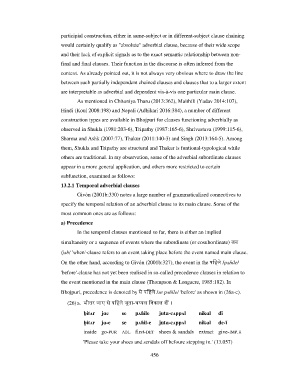
                           Bhojpuri, precedence is denoted by से पिहले /se pʌɦile/ 'before' as shown in (26a-c).
                             (26) a.  भीतर जाए से पिहले जूता-चwपल िनकाल दO ।

                                    b ̤ itʌr  jɑe   se    pʌɦile   jutɑ-cʌppʌl      nikɑl   dĩ

                                    b ̤ itʌr  jɑ-e   se   pʌɦil-e   jutɑ-cʌppʌl     nikɑl   de-ĩ
                                    inside  go-PUR  ABL  first-DET  shoes & sandals  extract  give-IMP.H

                                    'Please take your shoes and sendals off befoure stepping in.' (13.057)

                                                                456

