


Page 481 - A GRAMMAR OF BHOJPURI _ PhD Dissertation 2020 TU
P. 481
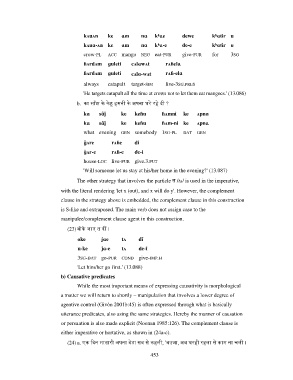
kʌuʌn ke ɑm nɑ kʰɑe dewe kʰɑtir u
kʌuɑ-ʌn ke ɑm nɑ kʰɑ-e de-e kʰɑtir u
crow-PL ACC mango NEG eat-PUR give-PUR for 3SG
ɦʌrdʌm ɡuleti cʌlɑwʌt rʌɦelɑ
ɦʌrdʌm ɡuleti cʌl ɑ-wʌt rʌɦ-elɑ
always catapult target-SIM live-3SG.PRES
'He targets catapult all the time at crows not to let them eat mangoes.' (13.086)
b. का साँझ के केi हमनी के अपना घरे रहे दी ?
kɑ sɑ ̃ ȷ ̈ ke keɦu ɦʌmni ke ʌpnɑ
kɑ sɑ ̃ ȷ ̈ ke keɦu ɦʌm-ni ke ʌpnɑ
what evening GEN somebody 1SG-PL DAT GEN
ɡ ̈ ʌre rʌɦe di
ɡ ̈ ʌr-e rʌɦ-e de-i
house-LOC live-PUR give.3.FUT
'Will someone let us stay at his/her home in the evening?' (13.087)
The other strategy that involves the particle त /tʌ/ is used in the imperative,
with the literal rendering 'let x (out), and x will do y'. However, the complement
clause in the strategy above is embedded, the complement clause in this construction
is S-like and extraposed. The main verb does not assign case to the
manipulee/complement clause agent in this construction.
(23) ओके जाए त दO ।
oke jɑe tʌ dĩ
u-ke jɑ-e tʌ de-ĩ
3SG-DAT go-PUR COND give-IMP.H
'Let him/her go first.' (13.088)
b) Causative predicates
While the most important means of expressing causativity is morphological
a matter we will return to shortly manipulation that involves a lower degree of
agentive control (Givón 2001b:45) is often expressed through what is basically
utterance predicates, also using the same strategies. Hereby the manner of causation
or persuation is also made explicit (Noonan 1985:126). The complement clause is
either imperative or hortative, as shown in (24a-c).
(24) a. एक !दन मातारी अपना बेटा सब से कहली, बउआ, अब घरही रहला से काम ना चली ।
453

