


Page 67 - A GRAMMAR OF BHOJPURI _ PhD Dissertation 2020 TU
P. 67
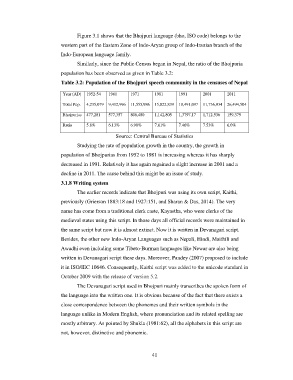
Figure 3.1 shows that the Bhojpuri language (bho, ISO code) belongs to the
                           western part of the Eastern Zone of Indo-Aryan group of Indo-Iranian branch of the

                           Indo-European language family.
                                 Similarly, since the Public Census began in Nepal, the ratio of the Bhojpuria
                           population has been observed as given in Table 3.2:

                           Table 3.2: Population of the Bhojpuri speech community in the censuses of Nepal

                           Year (AD)  1952-54   1961    1971      1981      1991      2001      2011

                           Total Pop.   4,235,079  9,412,996  11,555,986  15,022,839  18,491,097  11,736,934  26,494,504

                           Bhojpurias  477,281   577,357   806,480   1,142,805   1,3797,17   1,712,536   159,379
                           Ratio     5.8%     6.13%     6.98%     7.61%     7.46%     7.53%     6.0%

                                                 Source: Central Bureau of Statistics
                                 Studying the rate of population growth in the country, the growth in

                           population of Bhojpurias from 1952 to 1981 is increasing whereas it has sharply
                           decreased in 1991. Relatively it has again regained a slight increase in 2001 and a

                           decline in 2011. The cause behind this might be an issue of study.
                           3.1.8 Writing system

                                 The earlier records indicate that Bhojpuri was using its own script, Kaithi,
                           previously (Grierson 1883:18 and 1927:151, and Sharan & Das, 2014). The very
                           name has come from a traditional clerk caste, Kayastha, who were clerks of the

                           medieval states using this script. In those days all official records were maintained in
                           the same script but now it is almost extinct. Now it is written in Devanagari script.

                           Besides, the other new Indo-Aryan Languages such as Nepali, Hindi, Maithili and
                           Awadhi even including some Tibeto-Burman languages like Newar are also being

                           written in Devanagari script these days. Moreover, Pandey (2007) proposed to include
                           it in ISO/IEC 10646. Consequently, Kaithi script was added to the unicode standard in

                           October 2009 with the release of version 5.2.
                                 The Devanagari script used in Bhojpuri mainly transcribes the spoken form of
                           the language into the written one. It is obvious because of the fact that there exists a

                           close correspondence between the phonemes and their written symbols in the
                           language unlike in Modern English, where pronunciation and its related spelling are

                           mostly arbitrary. As pointed by Shukla (1981:62), all the alphabets in this script are
                           not, however, distinctive and phonemic.


                                                                41

