


Page 227 - A GRAMMAR OF BHOJPURI _ PhD Dissertation 2020 TU
P. 227
CHAPTER 7
SIMPLE VERBAL CLAUSES AND ARGUMENT STRUCTURE
7.0 Outline
This chapter deals with the different types of simple clauses in Bhojpuri. Section
7.1 introduces nonverbal or nominal clauses with presence of copula. In the section 7.2,
verbal clauses are introduced with sub-classification of verbs based on argument
structure and transitivity. We summarise findings of the chapter in section 7.3.
7.1 Nonverbal or nominal clauses
As Chitoniya Tharu (Paudyal 2013:307), Maithili (Yadav 2014:32), Hindi
(Koul 2008:207) and Nepali (Adhikari 2016:319) display, a nominal predication
typically occurs with the particular copular form. A question of phrasal identity
primarily falls under such type of construction. Whether it is another noun phrase, an
adjective phrase or a locative expression, it represents such permanent or temporary
state. Moreover, it is also related to the semantic distinction between equation or
identification, property and location, as well as to tense.
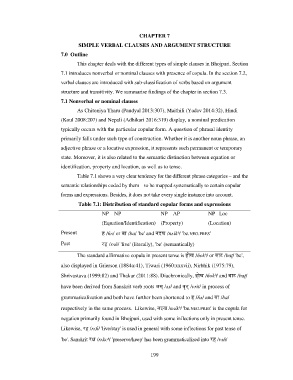
Table 7.1 shows a very clear tendency for the different phrase categories and the
semantic relationships coded by them to be mapped systematically to certain copular
forms and expressions. Besides, it does not take every single instance into account.
Table 7.1: Distribution of standard copular forms and expressions
NP NP NP AP NP Loc
(Equation/Identification) (Property) (Location)
Present ह /ɦʌ/ or बा /bɑ/ 'be' and नइख /nʌikʰ/ 'be.NEG.PRES'
Past रह /rʌɦ/ 'live' (literally), 'be' (semantically)
The standard affirmative copula in present tense is होख /ɦokʰ/ or बाट /bɑʈ/ 'be',
also displayed in Grierson (1884a:41), Tiwari (1960:xxxvii), Nirbhik (1975:79),
Shrivastava (1999:82) and Thakur (2011:88). Diachronically, होख /ɦokʰ/ and बाट /bɑʈ/
have been derived from Sanskrit verb roots अस् /ʌs/ and वृत् /vrit/ in process of
grammaticalization and both have further been shortened to ह /ɦʌ/ and बा /bɑ/
respectively in the same process. Likewise, नइख /nʌikʰ/ 'be.NEG.PRES' is the copula for
negation primarily found in Bhojpuri, used with some inflections only in present tense.
Likewise, रह /rʌɦ/ 'live/stay' is used in general with some inflections for past tense of
'be'. Sanskrit र" /rʌkcʰ/ 'preserve/keep' has been grammaticalized into रह /rʌɦ/
199

