


Page 225 - A GRAMMAR OF BHOJPURI _ PhD Dissertation 2020 TU
P. 225
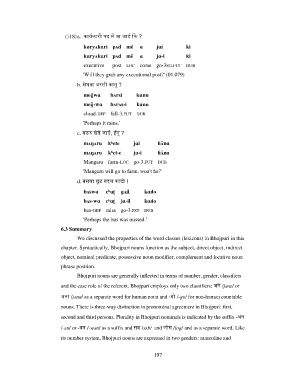
(118) a.  कायOकारी पद म) आ जाई 6क ?

                                    kɑryʌkɑri  pʌd  mẽ  ɑ         jɑi          ki
                                    kɑryʌkɑri  pʌd  mẽ  ɑ         jɑ-i         ki
                                    executive   post  LOC  come  go-3SG.FUT  DUB

                                    'Will they grab any executional post?' (01.079)

                                 b. मेघवा बरसी कानू ?
                                    meɡ ̈ wɑ   bʌrsi      kɑnu

                                    meɡ ̈ -wɑ   bʌrʌs-i   kɑnu
                                    cloud-DEF  fall-3.FUT  DUB

                                    'Perhaps it rains.'
                                 c. मङ> खेते जाई, हँनू ?

                                    mʌŋʌru  kʰete        jɑi       ɦʌ ̃ nu
                                    mʌŋʌru  kʰet-e       jɑ-i      ɦʌ ̃ nu

                                    Mangaru  farm-LOC  go-3.FUT  DUB
                                    'Mangaru will go to farm, won't he?'

                                 d. बसवा छूट गइल कादो !
                                    bʌswɑ    cʰuʈ  ɡʌil      kɑdo

                                    bʌs-wɑ  cʰuʈ  jɑ-il      kɑdo
                                    bus-DEF  miss  go-3.PST  DUB

                                    'Perhaps the bus was missed.'
                           6.3 Summary

                                 We discussed the properties of the word classes (lexicons) in Bhojpuri in this
                           chapter. Syntactically, Bhojpuri nouns function as the subject, direct object, indirect
                           object, nominal predicate, possessive noun modifier, complement and locative noun

                           phrase position.
                                 Bhojpuri nouns are generally inflected in terms of number, gender, classifiers

                           and the case role of the referent. Bhojpuri employs only two classifiers: जने /jʌne/ or

                           जना /jʌnɑ/ as a separate word for human noun and -गो /-ɡo/ for non-human countable
                           nouns. There is three-way distinction in pronominal agreement in Bhojpuri: first,

                           second and third persons. Plurality in Bhojpuri nominals is indicated by the suffix -अन

                           /-ʌn/ or -वन /-wʌn/ as a suffix and सब /sʌb/  and लोग /loɡ/ and as a separate word. Like

                           its number system, Bhojpuri nouns are expressed in two genders: masculine and


                                                                    197

