


Page 219 - A GRAMMAR OF BHOJPURI _ PhD Dissertation 2020 TU
P. 219
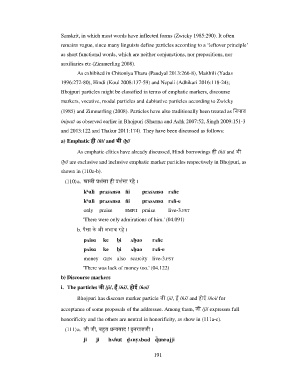
Sanskrit, in which most words have inflected forms (Zwicky 1985:290). It often
remains vague, since many linguists define particles according to a leftover principle
as short functional words, which are neither conjunctions, nor prepositions, nor
auxiliaries etc (Zimmerling 2008).
As exhibited in Chitoniya Tharu (Paudyal 2013:266-8), Maithili (Yadav
1996:272-80), Hindi (Koul 2008:137-59) and Nepali (Adhikari 2016:118-24);
Bhojpuri particles might be classified in terms of emphatic markers, discourse
markers, vocative, modal particles and dubitative particles according to Zwicky
(1985) and Zimmerling (2008). Particles have also traditionally been treated as िनपात
/nipat/ as observed earlier in Bhojpuri (Sharma and Ashk 2007:52, Singh 2009:151-3
and 2013:122 and Thakur 2011:174). They have been discussed as follows:
a) Emphatic ही /ɦi/ and भी /b̤ i/
As emphatic clitics have already discussed, Hindi borrowings ही /ɦi/ and भी
/b ̤ i/ are exclusive and inclusive emphatic marker particles respectively in Bhojpuri, as
shown in (110a-b).
(110) a. खाली शंसा ही शंसा रहे ।
kʰɑli prʌsʌnsɑ ɦi prʌsʌnsɑ rʌɦe
kʰɑli prʌsʌnsɑ ɦi prʌsʌnsɑ rʌɦ-e
only praise EMPH praise live-3.PST
'There were only admirations of him.' (04.091)
b. पैसा के भी अभाव रहे ।
pʌisɑ ke b ̤ i ʌb ̤ ɑo rʌɦe
pʌisɑ ke b ̤ i ʌb ̤ ɑo rʌɦ-e
money GEN also scarcity live-3.PST
'There was lack of money too.' (04.122)
b) Discourse markers
i. The particles जी /ji/, हँ /ɦʌ/, होई /ɦoi/
̃
̃
Bhojpuri has discours marker particle जी /ji/, हँ /ɦʌ/ and होई /ɦoi/ for
acceptance of some proposals of the addressee. Among them, जी /ji/ expresses full
honorificity and the others are neutral in honorificity, as show in (111a-c).
(111) a. जी जी, बzत धयवाद ! ढुनराजजी ।
̈
ji ji bʌɦut d ̤ ʌnyʌbɑd ɖunrɑjji
191

