


Page 125 - A GRAMMAR OF BHOJPURI _ PhD Dissertation 2020 TU
P. 125
a.  Schwa deletion
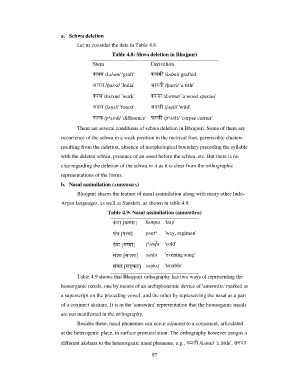
                                 Let us consider the data in Table 4.8.

                                                Table 4.8: Shwa deletion in Bhojpuri
                                        Stem                    Derivation

                                        कलम /kʌlʌm/ 'graft'     कलमी /kʌlmi/ grafted

                                        भारत /b ̤ ɑrʌt/ 'India'   भारती /b ̤ ɑrti/ 'a title'
                                        करम /kʌrʌm/ 'work'      करमा /kʌrmɑ/ 'a wood species'

                                        जङल /jʌŋʌl/ 'forest'    जङली /jʌŋli/ 'wild'

                                        फरक /pʰʌrʌk/ 'difference'  फरक$ /pʰʌrki/ 'corpse carrier'

                                 There are several conditions of schwa deletion in Bhojpuri. Some of them are
                           occurrence of the schwa in a weak position in the metrical foot, permissible clusters

                           resulting from the deletion, absence of morphological boundary preceding the syllable
                           with the deleted schwa, presence of an onset before the schwa, etc. But there is no

                           clue regarding the deletion of the schwa in it as it is clear from the orthographic
                           representations of the forms.

                           b.  Nasal assimilation (ʌnuswɑrʌ)
                                 Bhojpuri shares the feature of nasal assimilation along with many other Indo-
                           Aryan languages, as well as Sanskrit, as shown in table 4.9.

                                              Table 4.9: Nasal assimilation (anuswāra)

                                                कंपा [क8पा]   kʌmpɑ  'trap'
                                                पंथ [प9थ]     pʌntʰ   'way, regimen'
                                                                  ̈
                                                ठंढा [ठTढा]   ʈʰʌnɖɑ  'cold'

                                                संझा [सVझा]   sʌnȷ ̈ ɑ   'evening song'

                                                संकट [स:कट]  sʌŋkʌʈ  'trouble'

                                 Table 4.9 shows that Bhojpuri orthography has two ways of representing the
                           homorganic nasals, one by means of an archiphonemic device of 'anuswāra' marked as
                           a superscript on the preceding vowel, and the other by representing the nasal as a part

                           of a conjunct akshara. It is in the 'anuswāra' representation that the homorganic nasals
                           are not manifested in the orthography.

                                 Besides these, nasal phonemes can occur adjacent to a consonant, articulated
                           at the heterogenic place, in surface pronunciation. The orthography however assigns a

                           different akshara to the heterorganic nasal phoneme, e.g., कमती /kʌmti/ 'a little', धनपत

                                                                97

