Page 76 - Bhojpuri Verb Morphology
P. 76
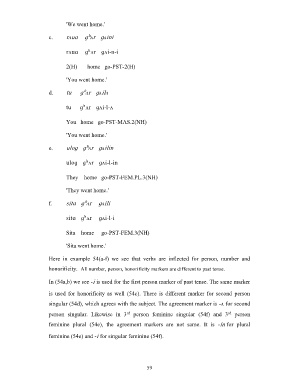
'We went home.'

                    c.     


                           --

                           2(H)       home   go-PST-2(H)

                           'You went home.'


                    d.     

                           --


                           You   home   go-PST-MAS.2(NH)

                           'You went home.'

                    e.     

                           --


                           They    home   go-PST-FEM.PL.3(NH)

                           'They went home.'

                    f.     


                           --


                           Sita    home     go-PST-FEM.3(NH)

                           'Sita went home.'

                    Here  in  example  54(a-f)  we  see  that  verbs  are  inflected  for  person,  number  and
                    honorificity.  All number, person, honorificity markers are different to past tense.


                    In (54a,b) we see -is used for the first person marker of past tense. The same marker
                    is  used  for  honorificity  as  well  (54c).  There  is  different  marker  for  second  person

                    singular (54d), which agrees with the subject. The agreement marker is - for second
                                                                                          rd
                                                  rd
                    person  singular.  Likewise  in  3   person  feminine  singular  (54f)  and  3   person
                    feminine  plural  (54e),  the  agreement  markers  are  not  same.  It  is  -for  plural

                    feminine (54e) and -for singular feminine (54f).


                                                          59
   71   72   73   74   75   76   77   78   79   80   81