


Page 584 - A GRAMMAR OF BHOJPURI _ PhD Dissertation 2020 TU
P. 584
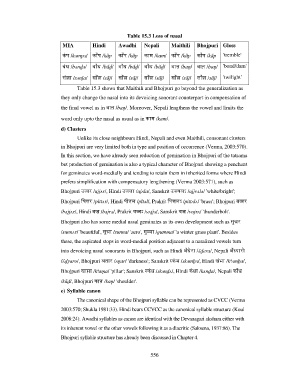
Table 15.3 Loss of nasal
                           MIA          Hindi      Awadhi    Nepali      Maithili   Bhojpuri  Gloss

                                                         ̃
                                              ̃
                                                                                          ̃
                                                                               ̃
                           कंप /kʌmpʌ/  काँप /kɑp  काँप /kɑp  काम /kɑm/  काँप /kɑp  काँप /kɑp   'tremble'
                           बंध /bʌnd ̤ ʌ/  बाँध /bɑd ̤ /  बाँध /bɑd ̤ /  बाँध /bɑd ̤ /  बाऩ /bɑn ̥ /  बाऩ /bɑn ̥ /  'bond/dam'
                                               ̃
                                                         ̃
                                                                    ̃
                                                                                ̃
                                                                                          ̃
                                                                    ̃
                                               ̃
                           संझा /sʌnȷ ̈ ɑ/  साँझ /sɑȷ ̈ /  साँझ /sɑȷ ̈ /  साँझ /sɑȷ ̈ /   साँझ /sɑȷ ̈ /  साँझ /sɑȷ ̈ /  'twilight'
                                                         ̃
                                 Table 15.3 shows that Maithili and Bhojpuri go beyond the generalization as
                           they only change the nasal into its devoicing sonorant counterpart in compensation of
                           the final vowel as in बाऩ /bɑn ̥ /. Moreover, Nepali lengthens the vowel and limits the
                           word only upto the nasal as usual as in काम /kɑm/.
                           d) Clusters

                                 Unlike its close neighbours Hindi, Nepali and even Maithili, consonant clusters
                           in Bhojpuri are very limited both in type and position of occurrence (Verma, 2003:570).
                           In this section, we have already seen reduction of gemination in Bhojpuri of the tatsama
                           but production of gemination is also a typical character of Bhojpuri showing a penchant
                           for geminates word-medially and tending to retain them in inherited forms where Hindi

                           prefers simplification with compensatory lengthening (Verma 2003:571), such as
                           Bhojpuri उ9र /ujjʌr/, Hindi उजला /ujʌlɑ/, Sanskrit उ;वलऽ /ujjvʌlʌ/ 'white/bright';

                           Bhojpuri िप)र /pittʌr/, Hindi पीतल /pītʌl/, Prakrit िप)लऽ /pittʌlʌ/ 'brass'; Bhojpuri ब9र

                           /bʌjjʌr/, Hindi ब@ /bʌjrʌ/, Prakrit व9ऽ /vʌjjʌ/, Sanskrit व@ /vajrʌ/ 'thunderbolt'.
                           Bhojpuri also has some medial nasal geminates as its own development such as सुBर

                           /sunnʌr/ 'beautiful', सुBा /sunnɑ/ 'zero', गु$मा /ɡummɑ/ 'a winter grass plant'. Besides
                           these, the aspirated stops in word-medial position adjacent to a nasalized vowels turn
                           into devoicing nasal sonorants in Bhojpuri, such as Hindi अँधेरा /ʌd ̤ erɑ/, Nepali अँEयारो
                                                                                     ̃

                           /ʌd ̤ yɑro/, Bhojpuri अऩार /ʌn ̥ ɑr/ 'darkness'; Sanskrit Hकंभ /skʌmb ̤ ʌ/, Hindi खंभा /kʰʌmb ̤ ɑ/,
                            ̃
                           Bhojpuri खा!ा /kʰɑm ̥ ɑ/ 'pillar'; Sanskrit Hकंध /skʌnd ̤ ʌ/, Hindi कंधा /kʌnd ̤ ɑ/, Nepali काँध

                           /kɑd ̤ /, Bhojpuri काऩ /kɑn ̥ / 'shoulder'.
                             ̃
                           e) Syllable canon

                                 The canonical shape of the Bhojpuri syllable can be represented as CVCC (Verma
                           2003:570; Shukla 1981:33). Hindi bears CCVCC as the canonical syllable structure (Koul
                           2008:24). Awadhi syllables as canon are identical with the Devanagari akshara either with

                           its inherent vowel or the other vowels following it as a diacritic (Saksena, 1937:86). The
                           Bhojpuri syllable structure has already been discussed in Chapter 4.


                                                                556

